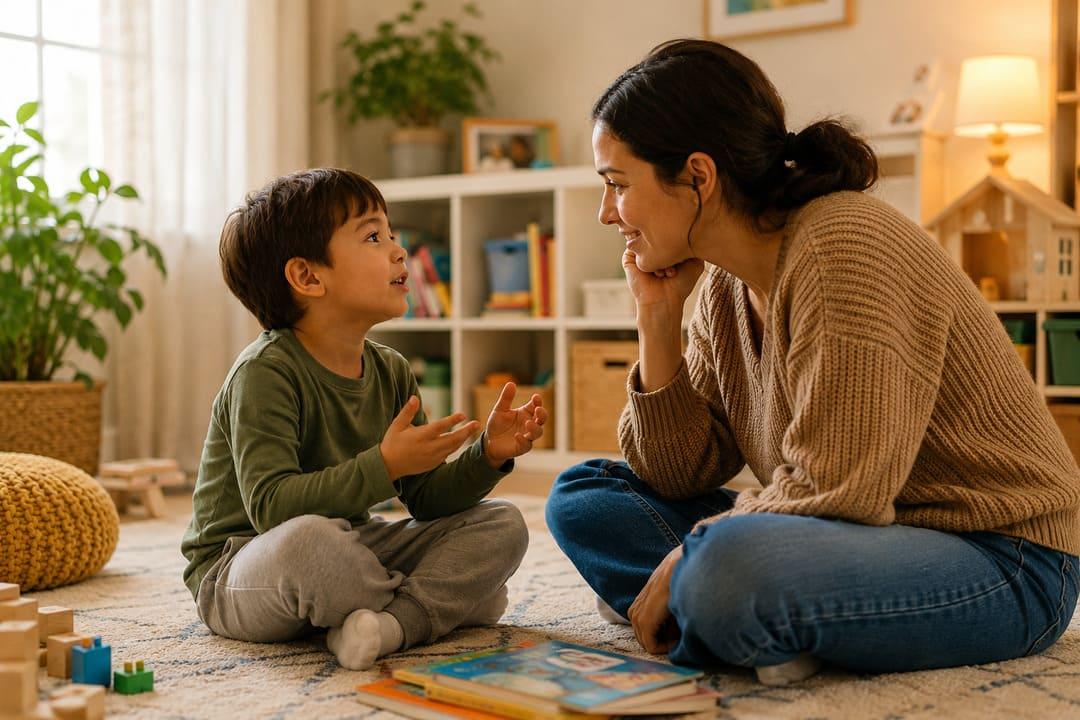
Safe child communication begins long before a child chooses the perfect words. A child who feels judged, rushed, mocked, ignored, or overwhelmed may still speak, but they often stop revealing what they really mean.
That matters because families are paying closer attention to speech, language, emotional regulation, and social confidence at home. Talk and play are not separate from safety; they are often the clearest signs that a child trusts the room enough to try.
Why Safe Child Communication Starts Before Words
Children do not communicate only through vocabulary. They communicate through pauses, gestures, facial expressions, eye contact, play choices, body movement, silence, and repeated questions. Adults often miss this because they listen mainly for clear sentences.
A child who feels safe has more room to experiment. They can say a word incorrectly, ask the same question again, disagree, admit confusion, or describe a feeling without immediately protecting themselves from criticism.
That does not mean every conversation must be gentle, quiet, or perfectly calm. Children also need limits, routines, and honest correction. The difference is whether correction feels like guidance or threat.
The safest communication environments are not permissive; they are predictable. A child can handle being told “not that way” when they also know the adult is still emotionally available after the mistake.
Fear Makes Children Edit Themselves
When children feel unsafe, they often become strategic. Some go quiet. Some become silly. Some argue. Some give the answer they think an adult wants. Others communicate through behavior because words feel too risky.
That behavior is easy to misread as defiance or immaturity. In many cases, it is self-protection.
A child who expects a sharp reaction may avoid explaining what happened. A child who has been laughed at may stop practicing difficult sounds. A child who feels rushed may answer “I don’t know” because it ends the pressure faster than trying.
The adult may see a communication problem. The child may be managing emotional risk.
This is why active listening games can be more than playful practice. They help children experience listening as something shared, not something they must perform correctly under pressure.
The Adult Response Teaches The Child What Is Safe To Say
Children study adult reactions closely. A parent’s face, tone, timing, and body language can either widen the conversation or close it.
When a child says something awkward, emotional, or incomplete, the first adult response matters. A calm response tells the child, “This is a place where unfinished thoughts are allowed.” A rushed correction tells the child, “Only polished answers are welcome.”
That distinction shapes how children handle harder conversations later. A child who can safely say “I’m scared,” “I don’t understand,” or “I did something wrong” has more than language skills. They have a working model for trust.
The child-development concept of serve and return interactions explains why responsive back-and-forth exchanges matter so much. Children make a sound, gesture, or comment; adults notice and respond; the child learns that communication has power.
| Adult Pattern | Child’s Likely Experience | Better Communication Signal |
|---|---|---|
| Interrupting quickly | My words are not worth finishing | Longer explanations |
| Correcting every mistake | Speaking is risky | More attempts, even imperfect ones |
| Staying calm during big feelings | I can talk when upset | More emotional language |
| Offering choices | My voice has some control | Clearer preferences |
| Repairing after conflict | Mistakes do not end connection | More honesty after tension |
Play Gives Children A Lower-Pressure Way To Tell The Truth
Direct questions can feel big to children. “Why did you do that?” or “What are you feeling?” may be too abstract, especially when emotions are already high.
Play lowers the stakes. A child may explain a puppet’s fear before naming their own. They may build a tower that keeps falling and reveal frustration through the story. They may act out a conflict between toy animals before they can describe a real one.
This is not avoidance. It is translation.
Play allows children to communicate from the side instead of under a spotlight. For younger children, that can be the difference between shutting down and showing what is happening inside.
Adults should pay attention to patterns in play, not treat every pretend moment as a hidden confession. The goal is not to interrogate play. The goal is to create enough emotional space for language, imagination, and meaning to surface naturally.
Safety Does Not Mean Avoiding Correction
Some adults worry that emotional safety means never challenging a child. That is a misunderstanding.
Children need adults to help them speak clearly, listen to others, wait their turn, use respectful words, and repair harm. Safe communication does not remove expectations. It makes expectations easier to receive.
A useful correction names the behavior without attacking the child. “Try that sentence again with a calmer voice” is different from “Why are you always so rude?” One gives the child a path forward. The other turns communication into shame.
Families tracking speech and language milestones should also remember that emotional comfort and developmental support can work together. A child may need modeling, repetition, professional guidance, or structured practice, but those supports work best when the child does not feel exposed or defective.
Signals That Trust Is Becoming Stronger Communication
Progress is not always loud. Sometimes the first sign of safer communication is that a child says “no” more clearly. Sometimes they ask for help sooner. Sometimes they tell a longer story, correct themselves, or admit they are upset instead of melting down.
These are not small wins. They show the child is beginning to believe words can help.
Parents and caregivers should watch for a few pressure points: more screen-heavy routines, rushed family schedules, adult stress, inconsistent discipline, and environments where children hear constant correction but little curiosity. These pressures can make communication feel transactional.
A stronger pattern is simple but demanding: slow down, notice the child’s attempt, respond to the meaning, then shape the words when needed.
Connection opens the door, but consistency keeps it open. Children communicate better when they know the adult response will not change wildly from patience one day to ridicule the next.
Safe child communication is not a soft extra in child development. It is the ground that makes honest language possible. When children feel safe enough to try, stumble, repair, and try again, communication becomes more than speech; it becomes trust in motion.