Bilingual communication skills can look messy before they look impressive. A young child may mix words, understand more than they say, or prefer one language in one setting and another language at home, which can make parents wonder whether two languages are helping or slowing progress.
The stronger view is that bilingual development often builds communication flexibility long before adults can measure it neatly. Families looking for practical daily support can use these simple bilingual parenting tips for confident communicators while remembering that early bilingual growth is not supposed to look perfectly balanced every day.
Bilingual Communication Skills Grow Through Choice And Context
A child learning two languages is not simply collecting two sets of words. They are learning when to use language, with whom, for what purpose, and in which social setting. That is a more complex communication task than many adults realize.
A toddler may use one language with a grandparent, another with a preschool teacher, and a mixture with siblings. That shift is not automatically confusion. It may be the child beginning to understand that communication changes depending on the listener.
This matters because strong communication is not only about vocabulary size. It is also about flexibility, attention, listening, turn-taking, repair, and social awareness. A bilingual child often has daily practice noticing who understands what. That practice can make language feel more purposeful.
The key is not to demand perfect separation between languages too early. The key is to give the child enough meaningful interaction in each language so both remain useful. Communication flexibility grows when children have real reasons to use words, gestures, sounds, and expressions with people who matter to them.
Mixing Languages Can Be A Communication Strategy
Language mixing often worries parents because it looks unfinished. A child may say, “I want leche,” or “More agua,” or begin a sentence in one language and end it in another. Adults may hear disorder. The child may be choosing the strongest word available.
That choice can be efficient. A toddler may know the snack word in one language because that is what they hear at home. They may know the playground word in another language because that is what they hear from other children. The vocabulary is not always divided evenly because life is not divided evenly.
The American Speech-Language-Hearing Association’s page on learning more than one language gives families a useful way to think about practice, support, and normal multilingual patterns without treating every mixed sentence as a warning sign.
Parents can respond by modeling, not scolding. If a child says, “More leche,” an adult might say, “More milk,” or answer in the family language depending on the household goal. The child hears a complete version without being made to feel wrong.
That tone matters. Children who feel corrected every time they attempt communication may speak less. Children who feel understood often try more. In bilingual homes, mixing is not failure; it can be a bridge between what the child knows now and what they will be able to say later.
Stronger Communication Comes From More Than Word Counts
Parents often ask how many words a bilingual toddler “should” have in each language. That question is understandable, but it can become too narrow. A child’s vocabulary may be distributed across languages, meaning some words appear in one language and different words appear in another.
A better question is whether the child is communicating across the whole environment. Are they pointing, responding, imitating, requesting, protesting, playing, understanding routines, and trying to connect? Those signals matter because communication develops as a system.
The table below shows how bilingual experience can support broader communication skills when children receive consistent, meaningful exposure.
| Bilingual Experience | Communication Skill It Can Support | What Parents Can Do |
|---|---|---|
| Hearing different people use different languages | Listener awareness | Name who uses which language naturally |
| Switching languages by setting | Social flexibility | Keep language routines predictable |
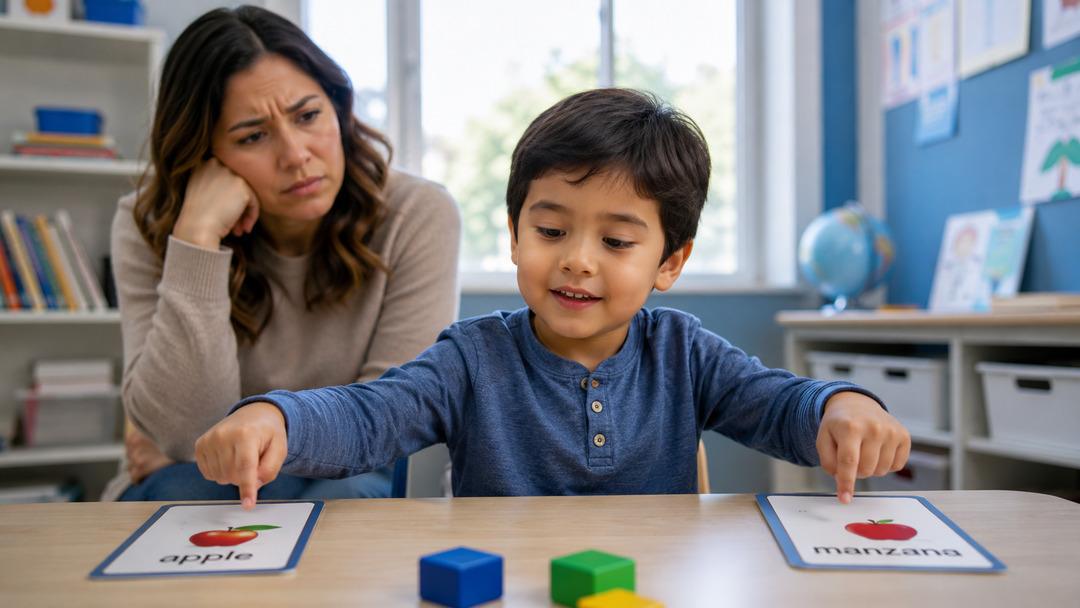
| Using one word from each language | Vocabulary access | Model full phrases without pressure |
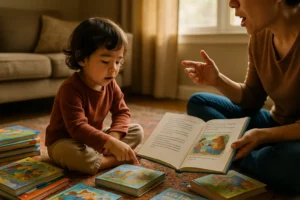
| Hearing stories in the home language | Narrative understanding | Read, retell, and talk about pictures |
| Speaking with relatives in another language | Relationship-based communication | Create regular calls, visits, or songs |
The point is not that bilingualism automatically solves every communication challenge. It is that bilingual children often practice communication in layered ways: they track people, settings, meaning, tone, and shared history.
That kind of practice should not be dismissed because the child’s speech sounds uneven. Early language is uneven for many children. In bilingual development, the unevenness may simply be more visible.
The Home Language Builds More Than Vocabulary
One of the most damaging myths is that families should reduce the home language to help the child succeed in the majority language. That advice may sound practical, especially when school readiness becomes a concern. But it can weaken the child’s richest source of language.
Parents speak best when they can be warm, detailed, playful, and emotionally precise. If a parent is most expressive in the home language, that language gives the child access to deeper conversation. It carries jokes, comfort, discipline, stories, affection, family history, and identity.
The HealthyChildren.org guide to young children learning multiple languages is especially useful for families who worry that multilingual exposure causes confusion or delay.
The practical lesson is simple: do not trade rich language for limited language. A parent using short, uncomfortable phrases in a less familiar language may offer less communication overall than a parent speaking naturally in the language they know best.
The home language also helps children stay connected to relatives and community. That connection can create more chances to speak, listen, ask, answer, joke, and negotiate meaning. Home language matters because communication is relational, not just academic.
Parents Should Watch Patterns, Not Isolated Moments
A bilingual child may have quiet days, mixed sentences, uneven vocabulary, or a temporary preference for one language. None of those patterns alone should cause panic. What matters is the larger communication picture over time.
Parents should watch whether the child is gaining new ways to communicate. Are gestures increasing? Is comprehension growing? Does the child use sounds or words to get attention? Do they respond to familiar routines? Are they interested in people, play, and shared moments?
Concerns become more meaningful when difficulties appear across languages and settings. If a child struggles to understand simple directions in both languages, rarely gestures, loses skills, avoids interaction, or shows limited attempts to communicate, parents should seek professional guidance.
The goal is not to wait passively. It is to respond with clear eyes. Bilingualism should not be blamed for every delay, but real concerns should not be ignored under the assumption that “two languages just take longer.”
Families need a balanced standard: protect both languages, build daily interaction, and ask for support when the whole communication picture feels stuck. Whole-child signals are more useful than judging one isolated word list.
The Next Advantage Is Confidence Across People And Places
The strongest bilingual development happens when children experience both languages as useful, loved, and socially meaningful. That requires more than exposure. It requires opportunity.
A child who hears a home language but is never invited to use it may understand it without speaking it. A child who is corrected harshly may avoid it. A child who sees the language connected to grandparents, games, music, food, books, cousins, and bedtime may begin to treat it as part of daily life.
Parents should pay attention to the emotional climate around each language. Is one language treated as more valuable? Is the child praised only when using the majority language? Are adults embarrassed by mixing? Those signals shape confidence.
Bilingual communication skills are not built by forcing children to perform perfectly in two languages. They are built through repeated, meaningful exchanges that teach children how language connects them to people. The opportunity ahead is not just raising children who can translate words. It is raising children who can listen across contexts, adapt to different speakers, and carry more than one language into real relationships with confidence.