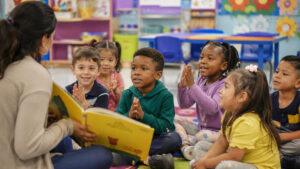
What if the key to unlocking your child’s communication skills was already sitting in their lap, purring or waiting for a walk? Children have a natural, powerful bond with creatures big and small.
This connection isn’t just cute—it’s a dynamic classroom. Structured play centered around caring for companions turns fun into foundational learning.
Through these activities, kids naturally grow their verb vocabulary. They learn action words like “feed,” “groom,” “walk,” and “comfort.”
More importantly, they expand their emotional word bank. They begin to name feelings like “concern,” “joy,” and “patience” that come with looking after another living being.
This playful approach introduces big ideas about duty and care in a way that feels safe and engaging. The theme of animals inherently captures attention, making lessons stick.
For parents and educators, it’s a ready-made tool. You can tap into this genuine interest to foster growth in both expression and empathy. Watch as caring for a pretend pet builds real-world skills.
Engagement power of animal themes
From a scientific view, playing with animals lights up a child’s brain. It’s not just fun. It connects to our deep need to care and bond.
When kids care for animals, even pretend ones, they feel a strong sense of purpose. This purpose makes them focused and motivated. They see themselves as real veterinarians or farmers.
This emotional connection helps them remember what they learn. When they feel something, they remember it better. This makes learning stick and come back to them later.
Different animals teach different words. Pets teach grooming verbs like *brush*, *bathe*, and *dry*. Farms teach words like *milk*, *shear*, and *collect*.
Zoo animals teach about habitats and movement. Each setting offers a new chance to learn. This keeps learning fun and stops boredom.
The table below shows how animal themes help with language goals. Notice how grooming verbs and action words are key.
| Animal Theme | Sample Vocabulary Focus | Key Action & Care Verbs | Emotional & Descriptive Words |
|---|---|---|---|
| Household Pets (Dog, Cat) | Body parts (paw, tail, whiskers), needs | feed, walk, brush, bathe, pet, play | happy, sleepy, hungry, gentle, soft |
| Farm Animals (Cow, Sheep, Chicken) | Products (milk, wool, eggs), shelters | milk, shear, collect, feed, clean (pen) | loud, fluffy, busy, hungry, muddy |
| Zoo & Wild Animals (Lion, Elephant, Monkey) | Habitats, foods, movements | observe, feed, mimic (swing, roar), protect | wild, strong, playful, giant, careful |
Start with what your child loves. Use their interests in animals as a base. A child who loves lions will dive into lion care.
This deep engagement is perfect for learning. When a child is fully into brushing a toy horse, they’re ready to learn. Learning specific verbs becomes easy.
Animal-themed play connects simple fun to real language growth. It turns everyday actions into stories of care and responsibility. This is the power of engagement that makes learning last.
Setting up a vet/groomer kit with safe props and checklists
Let’s get started on a fun vet or groomer kit. It turns everyday items into learning tools. This project is great for your child’s pet care journey.
You don’t need expensive toys or a big budget. The best kits use safe, common items from home. Collecting these props is the first fun step.
Here’s a simple list of household items for your caring routines kit:
- A soft-bristle brush or clean makeup brush: Perfect for gentle grooming.
- A toy stethoscope or a funnel: Lets kids listen to a stuffed animal’s “heartbeat.”
- A small bowl or cup: For serving pretend food and water.
- Child-safe plastic tweezers or clothespins: Ideal for removing imaginary ticks or burrs.
- A washcloth or small towel: Used for bathing and drying.
- An empty, clean spray bottle: Filled with water for misting a pet’s fur.
Be creative with DIY ideas. A ribbon can be a collar, and a sock a cozy sweater. Decorating a shoebox for the kit makes it extra special.
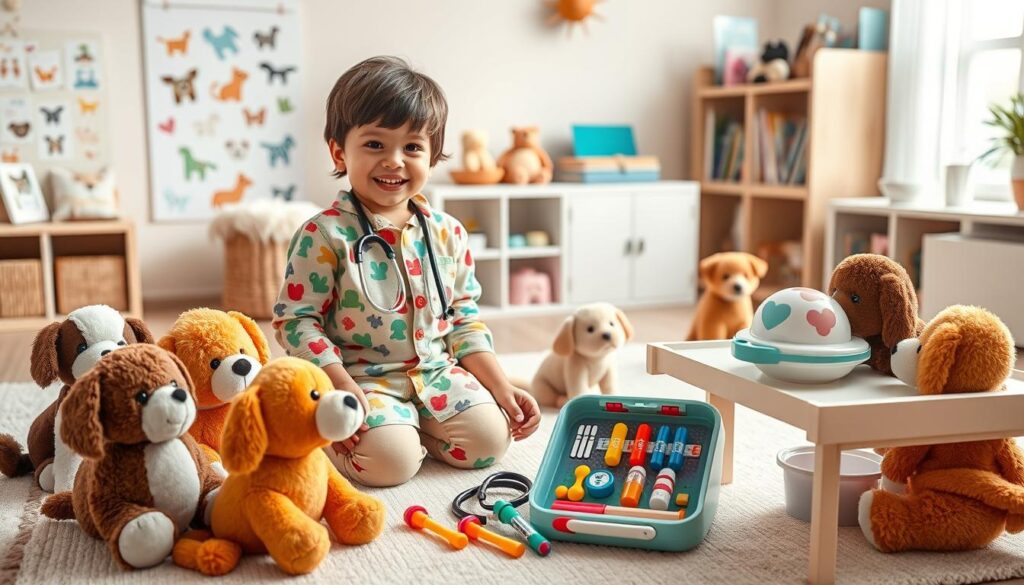
A printable checklist is very helpful. Let your child mark off each item as you find it. This builds excitement and teaches them to organize.
Remember, setting up the kit is a language-rich activity. Name each item as you handle it. Use verbs like find, gather, place, and organize. This preparation lays the verbal foundation for all the play to come.
Your finished kit creates a welcoming play space for nurturing. When your child sees it, they know it’s time for gentle, focused caring routines. The simple act of preparation teaches responsibility and sparks joy.
Language goals: care verbs, body parts, feelings, and gentle touch
When a child pretends to feed a stuffed dog or brush a toy cat, they’re learning about care and empathy. This play is more than just actions. It’s a secret classroom for learning language.
Setting clear language goals helps make playtime more focused. You don’t need to be a teacher. Just know which words to highlight.
We can break these goals into four easy categories:
- Care Verbs: These are the action words of nurturing. Use words like feed, brush, walk, bathe, pet, and cuddle. Say, “Let’s brush the bunny’s fur,” or “It’s time to walk the dog.”
- Animal Body Parts: Naming parts builds descriptive skills. Point out the paw, whiskers, tail, ears, and nose. Ask, “Can you find the puppy’s paws?”
- Feelings Words: This is the heart of empathy language. Label the animal’s emotions: “The cat looks happy,” “The hamster seems sleepy,” or “The bird might feel scared.”
- Gentle Touch Phrases: These direct actions kindly. Use phrases like “soft pet,” “gentle hands,” and “nice and slow.”
Make language a part of play naturally. Comment on what you or your child is doing. Ask simple questions. Instead of just giving a toy a check-up, say, “I’m listening to the dog’s heart. It sounds strong.”
Focusing on feelings and gentle touch is very powerful. It teaches children to read non-verbal cues and respond with kindness. This builds true emotional intelligence.
Remember, your role is to be an engaged play partner, not a language expert. By consistently using these words, you create a rich learning environment. Your child will absorb the vocabulary through joyful repetition.
This approach makes empathy language a normal part of conversation. It turns care into a dialogue filled with new words and shared understanding.
Five routine scripts: feed, clean, check‑up, walk, bedtime
Ready to use care verbs and feelings words in action? Let’s explore five play routines. These scripts are your first tools. They help you feel confident and create patterns for kids to learn sequences, a key skill for supporting speech development.

Each script uses a simple “we do, you say” model. You act out the action and word, then ask your child to join in. Feel free to repeat, change the order, or let your child be the vet in charge!
1. The Feeding Routine
This routine focuses on action words and body parts. Use a bowl, pretend food, and a stuffed animal.
- “Our dog looks hungry. Let’s fill her bowl.” (Pretend to pour food).
- “Now we place it down for her. Good job!”
- “She’s eating! Her mouth is moving. Her tummy will be full.”
- “All done! Time to wash the bowl.”
2. The Cleaning Routine
This routine focuses on grooming verbs. Gather a soft brush, a cloth, and a toy tub.
- “Our pet got muddy! First, we brush her fur. Be gentle.”
- “Next, we wipe her paws with this damp cloth. Clean paws!”
- “If she’s really dirty, we can bathe her in the tub. Splash, splash!”
- “Lastly, we dry her off with a big towel. She feels happy and clean.”
3. The Check-Up Routine
Act as a doctor and explore body parts and feelings. Use a toy stethoscope and a notepad.
- “Time for a check-up! Let’s listen to her heart. Thump, thump.”
- “Now, check her ears. They look clean!”
- “Look at her eyes. Are they bright?”
- “I see a wagging tail. That means she is healthy!”
4. The Walking Routine
Act out a walk to introduce movement verbs and environmental words. Use a leash and navigate around pillows.
- “Let’s put on the leash. Click, it’s secure!”
- “We walk together. Slow steps.”
- “Oh! She wants to sniff the flower. Good smelling!”
- “She stops at the tree. Maybe she sees a squirrel!”
5. The Bedtime Routine
Wind down with calming actions and emotion words. Use a small blanket and a soft toy.
- “The sun is down. Our pet feels sleepy.”
- “Let’s fluff her bed so it’s cozy.”
- “We tuck her in with her blanket. Good night.”
- “Pat her head softly. Sweet dreams!”
These scripts are just the start. As your child becomes more comfortable, they’ll add their own steps and dialogue. This will help them develop incredible narrative thinking skills.
Social stories for empathy and kind handling
Social stories are powerful because they teach kindness. They help kids understand how to care for animals with compassion. These stories make complex feelings easy to grasp.
You can make them with photos, drawings, or dolls. A story like “Fluffy is Scared of the Bath” shows how to comfort a pet. It guides through gentle steps of caring routines.
Another story, “Rex Shares His Toy,” teaches about sharing. It asks why Rex might not want to share his bone. It shows how to ask nicely, preparing for real-life situations.
Social stories teach important skills:
- Empathy: “Fluffy’s heart beats fast. She feels scared.”
- Gentle Handling: “We use slow hands and a quiet voice.”
- Problem-Solving: “What can we do to help Fluffy feel safe?”
This method turns challenges into learning chances. It builds emotional smarts into daily caring routines.
Here’s how to structure these lessons:
| Story Scenario | Empathy & Language Goal | Simple Prop to Use |
|---|---|---|
| Bath Time Fear | Identifying fear, using calming words (“It’s okay”), and sequencing gentle steps. | A rubber duck and a washcloth for the child’s doll. |
| Sharing a Toy | Understanding possession, using polite requests (“Can I have a turn?”), and waiting. | Two stuffed animals and one toy bone. |
| Vet Visit Nerves | Recognizing nervousness, practicing comforting touch, and following a check-up checklist. | A toy stethoscope and a blanket for a “safe space.” |
By acting out these stories, kids learn the value of kindness. They see that caring routines are about connection, not just tasks.
This method is great for kids who need clear guidance. For more speech-language resources at Talk and Play, check out play-based learning strategies.
Ultimately, social stories teach the heart as much as the hands. They ensure every care action is done with understanding and respect.
Real‑life transfer with a family pet or stuffed‑animal chart
A simple, visual chart can be the perfect tool to help a child connect their playful learning to real-life situations. This step moves care from imagination to action, building a powerful sense of accomplishment.
If your family has a pet, safety is the absolute first rule. An adult must always supervise interactions. The chart tasks are designed for observation and assisted participation, not independent care.
The printable chart uses clear pictures and simple phrases. Children check off tasks as they complete them with guidance. This visual system makes responsibility feel manageable and fun.
For families without a live animal, a dedicated stuffed animal works wonderfully. The routine and emotional practice are just as valuable. The chart turns any plush friend into a focus for consistent care habits.
| Care Task | With a Family Pet (Supervised) | With a Stuffed Animal | Language & Empathy Focus |
|---|---|---|---|
| Fill Water Bowl | Help pour water into pet’s bowl. | Pretend to fill a bowl with imaginary water. | “You must be thirsty!” “Here’s a cool drink.” |
| Gentle Petting Time | Stroke pet gently on back or chin, as allowed. | Practice soft strokes on the stuffed animal. | “You seem calm.” “This feels nice, doesn’t it?” |
| Play & Exercise | Toss a toy for pet or watch them play. | Move stuffed animal around for “playtime.” | “You have so much energy!” “That was fun!” |
| Quiet Rest Time | Place pet’s bed in a quiet spot. | Tuck stuffed animal into a makeshift bed. | “You need a cozy nap.” “Shhh, time to rest.” |
| Brushing/Fur Care | Hold brush for adult or watch grooming. | Use a soft brush on the stuffed animal. | “Let’s make you look tidy.” “Your fur is so soft.” |
Checking off each task builds a child’s real-world competence and confidence. They see themselves as a capable helper. This tangible proof of their ability is incredibly motivating.
Every task is a chance to practice feelings and empathy language. Comment on the pet’s (or toy’s) imagined state. Use phrases like, “He looks happy after his walk,” or, “She seems sleepy now.” This labels emotions in an authentic context.
Celebrate this transfer of learning! Acknowledge the effort, not just perfection. This positive reinforcement ties kind actions directly to positive feelings, cementing the connection between responsibility and empathy.
Bilingual word wall and picture schedule
Picture schedules help kids follow steps clearly. Adding bilingual labels makes them even more useful. They turn abstract ideas into something kids can understand.
A bilingual word wall is a special place for key words. You can use a poster board or a wall section. Print important words in two languages and add pictures next to them.
Start with care verbs and nouns. Words like “feed/ alimentar,” “brush/ cepillar,” “water/ agua,” and “gentle/ suave” are great. This wall helps kids remember vocabulary every time they see it.
The picture schedule shows the order of care steps. Make cards with icons or photos for each step. Put them in order on a board or chart.
This schedule makes routines predictable, reducing anxiety. Kids can point to the next step, helping them feel independent. Use the same images from your word wall to link the schedule and vocabulary.
| Tool | Primary Purpose | Key Components | Sample Bilingual Labels |
|---|---|---|---|
| Word Wall | Vocabulary Reference & Language Exposure | Large printed words, matching images, clear headings | Walk / Pasear, Check-up / Revisión, Happy / Feliz |
| Picture Schedule | Routine Sequencing & Task Independence | Step-by-step icon cards, sequence strip or board, movable checkmarks | First / Primero, Then / Luego, All Done / Terminado |
| Combined Use | Integrated Learning & Skill Transfer | Matching games, “find the word” activities, schedule creation together | Find “Brush” / Encuentra “Cepillar”, What’s next? / ¿Qué sigue? |
Using these tools together is very effective. Before play, review the schedule and point to the words on the wall. After play, have your child match the picture cards to the words. This multi-sensory approach helps solidify learning.
This setup does more than organize play. It lays the groundwork for bilingual vocabulary and sequencing skills. It also boosts kids’ confidence in following routines. It turns everyday play into a structured language-learning adventure.
Printable care charts, exam forms, and emotion cards
Your pet care play journey is made real with printable tools. These resources add to your bilingual word wall and picture schedule. They make playtime a chance to learn consistently.
Downloadable care charts help kids keep track of feeding, walking, and grooming. This visual aid teaches responsibility. Pretend vet exam forms make check-ups more fun. Kids can practice writing like a real vet.
Emotion cards are great for learning about feelings. Use them to talk about a stuffed dog’s feelings during a pretend bath. Discuss a cat’s purrs or worried eyes. This helps everyone grow their animal vocabulary.
These printables make learning fun and structured. They help your child’s animal vocabulary grow in a fun way.
Get your crayons and clipboard ready. Print these free resources from sites like Teachers Pay Teachers or PBS Kids. Now, you have everything you need for this engaging play.