Raising a bilingual child isn’t like studying for a test. It’s more like a fun road trip with surprises and special moments. These moments make the journey worth it.
The best time for this adventure is between ages three and nine. It’s not a strict time frame. It’s when young minds soak up language like sponges.
Does your preschooler mix English and Spanish words? That’s not a mistake. It’s their brain working hard to learn. It’s a natural part of growing up.
We’re not racing to get your child fluent. We’re here to watch and guide them. We’ll follow their journey from first words to more complex language. The key is to match your approach to your child’s needs. Let’s enjoy the journey together.
Creating a Rich Home Environment
Forget the classroom. The most potent lab for supporting bilingual kids is your living room. Your mission is to create a linguistic ecosystem, not drill vocabulary.
This shift is from passive to active engagement. It’s not just handing your kid a Spanish app. It’s making dinner prep a chance to talk about los tomates and las cebollas. The goal is to make daily life rich in language.
Think of your home as an immersion studio. The curriculum is your family’s unique rhythm. Use your child’s interests, like dinosaurs, to teach them.
This approach aligns with expert advice. Successful practice needs routines and more language exposure. True parent engagement starts with trusting relationships and family needs.
So, how does this look in practice? Let’s break down the operational difference.
| Aspect | Passive Involvement (The Timeshare Model) | Active Engagement (The Curated Studio) |
|---|---|---|
| Core Philosophy | Language as a scheduled activity, like a weekly lesson. | Language as the living medium of daily interaction and play. |
| Daily Practice | Flashcards, designated “Spanish hour.” Feels like homework. | Labeling household items, narrating chores, singing during car rides. It’s life. |
| Parent Role | Manager or scheduler. “It’s time for your Spanish.” | Co-participant and model. “Pásame la leche, por favor.” |
| Child Experience | Task-oriented. Can create resistance. | Interest-driven and natural. Feels like discovery, not duty. |
| Long-term Outcome | Fragile knowledge, often seen as an external subject. | Robust, integrated language skills tied to emotion and memory. |
The right column isn’t about more effort. It’s about a different kind of effort. It’s making your kitchen table a place where language lives.
Start with one routine. Use bath time to name body parts. Read one book in the target language at bedtime. The energy comes from you, shaped by your family’s culture. This is how you build a rich home environment that supports bilingual kids every day.
You’re not teaching a language. You’re inviting it to live with you.
Choosing the Right Tools
Choosing tools for bilingual development is like picking between fast food and a farmer’s market. Fast food is quick but empty. A farmer’s market gives you ingredients for a lasting feast.
The app world is full of promises. “Learn fluency in five minutes a day!” It sounds good but is like snack food. It’s okay for a quick fix but won’t build a strong base.
We need better tools for what we’re building. A true family guide gives the structure, not just flash.
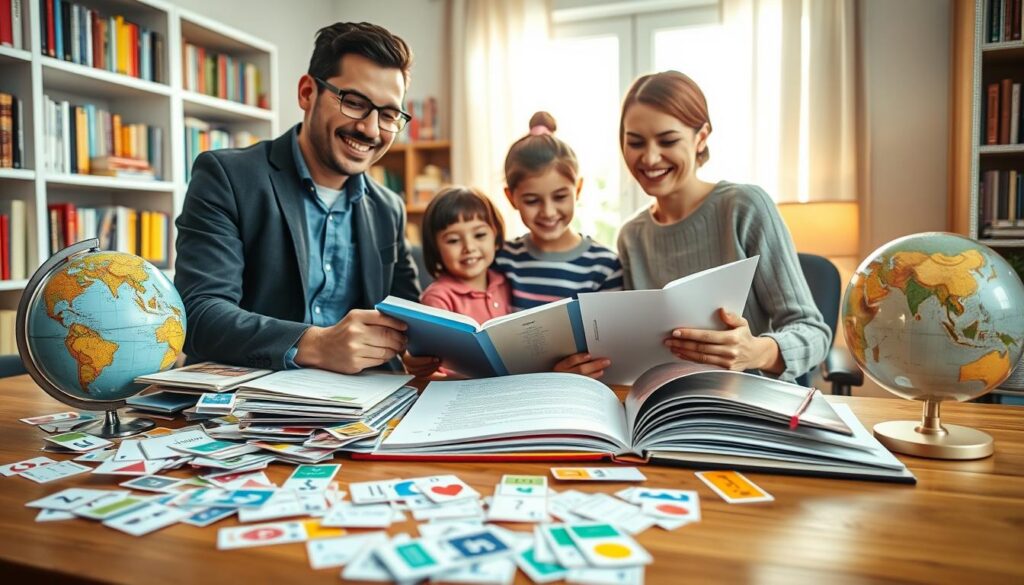
This structure has key pillars. First, it has pronunciation support for parents who aren’t fluent. You don’t need to be an expert to start. It turns hesitant attempts into shared victories, making sounds clear.
Second, it includes physical storybooks. They don’t need charging. They ask for snuggles, pointing, and turning pages. This is language you can hold.
Third, it has activity books for everyone. They’re not just for one person. They start conversations, drawing, and play. They help build a messy but rich connection.
The right tools don’t just teach Spanish. They help everyone discover together. The benefits are huge.
| Tool Type | Focus | Experience | Long-Term Value |
|---|---|---|---|
| App-Centric Tools | Individual fluency, gamification | Solitary, screen-based, passive consumption | Often plateaus; engagement is external (points, streaks) |
| Family Guide Tools | Shared comprehension, real-world use | Interactive, tactile, conversation-driven | Builds intrinsic motivation & family bonds; skills transfer to daily life |
| Pronunciation Apps | Perfecting individual accent | Private practice, often repetitive | Can improve speech, but lacks conversational context |
| Physical Storybooks & Activities | Contextual understanding, joint attention | Collaborative, sensory, creates shared memories | Fosters a love for language and culture; strengthens parent-child connection |
Choosing wisely means looking beyond digital hype. It’s about tools that bring your family together, not apart. The goal is a lively conversation, not a silent child on a tablet.
That’s the power of a well-curated family guide. It turns language learning into a family adventure.
Collaborative School Partnerships
The home-school partnership is often seen as a diplomatic summit. You share concerns, and they give reports. Everyone is polite, but it feels like a mismatch.
We aim to create a strategic alliance. It’s not just about attending parent-teacher nights. It’s about working together to set goals. A wise source says it’s about activating a team.
Imagine entering as a partner, not just a visitor. You bring knowledge about your child’s language. The school has its teaching methods. The shift is from fixing English to supporting bilingual identity.
This change requires a new conversation. We move from “What can they learn from us?” to “What can we learn from each other?” This journey will be challenging. But it’s the only way to honor the whole child.
Let’s explore this shift. Below is a table showing the change from a transactional to a collaborative model.
| Aspect | The Old Model: Transactional | The New Alliance: Collaborative |
|---|---|---|
| Primary Mindset | School as sole authority; home as support. | School and home as co-experts with complementary knowledge. |
| Communication Flow | One-way: school reports, parent listens. | Two-way dialogue: shared observations, joint strategy. |
| Focus of Meetings | Problems, deficits, and English acquisition. | Assets, holistic identity, and bilingual growth. |
| Parent Role | Passive recipient of information. | Active contributor to the educational plan. |
| Goal | Assimilation into monolingual classroom norms. | Integration of linguistic assets to enrich learning for all. |
Notice the difference? The collaborative model strengthens the home-school partnership. Your knowledge of your child’s language becomes valuable. Teachers might learn your language to connect better.
This partnership changes you from a bystander to a leader. You’re not just fighting for your child. You’re working with the school to celebrate bilingualism. It turns the school into a place of unity.
FAQs
Let’s tackle the top worries about being a cultural critic. These questions touch on our fears about being good enough, using our time wisely, and getting results. They’re the starting points for your family’s unique plan for learning and growth.
“Do I need to be fluent in Spanish?” No, you don’t need to be perfect. Your role is to be curious and learn together. Quality resources are like your helpers in the kitchen. You create the space for learning.
“What’s the ideal age to start?” The best time is between 3 and 9 years old. It’s when kids’ brains are most open to learning. This age is perfect for picking up new things without feeling self-conscious. Start when you feel ready, knowing the window is wide open.
“How is this different from just using an app?” Apps offer quick fixes, but our method builds a lasting learning environment. It’s like growing a garden, not just grabbing a snack. See the difference?

| The App Transaction | The Family Ecosystem |
|---|---|
| Philosophy: Isolated skill drill. | Philosophy: Integrated life experience. |
| Engagement: Screen-based, passive consumption. | Engagement: Multi-sensory, active participation. |
| Outcome: Vocabulary memorization. | Outcome: Cultural connection and linguistic growth. |
| Role of Parent: Digital gatekeeper. | Role of Parent: Cultural guide and fellow explorer. |
“What if we don’t speak Spanish at home?” Not speaking Spanish at home is actually a great start. It means you and your child can explore together. You’ll use resources to guide you, making your home a place of discovery. Not speaking Spanish is not a weakness. It’s the spark for a shared learning journey.
So, are these FAQs obstacles? No, they’re the keys to a successful bilingual journey. Your personalized plan begins here.
Overcoming Barriers
The bilingual journey isn’t easy. It’s like navigating Boston during rush hour with a broken GPS. You’ll hit walls. The excitement of learning new words will fade.
Schools might ignore your emails. Your child might stop speaking Spanish for a while. These aren’t failures. They’re just signs to learn more.
That advice to “think outside the box” is helpful. But what does it mean when your kid won’t cooperate? It means finding solutions in unexpected places.
Maybe the school program is stuck. Try working with the local library or cultural center instead. If textbooks are boring, use your child’s favorite video game to teach language.
This approach to bilingual development is different. See each obstacle as a chance to find a better way. The journey is the goal, not the destination.
| Common Barrier | Conventional Response | Unconventional Solution |
|---|---|---|
| Child refuses to speak the target language | Pressure, correction, formal practice | Introduce a “language character” puppet or use voice changers in games. Make it play, not work. |
| School partnership is slow or unresponsive | Wait for reply, get frustrated, give up | Bypass formal channels. Find a teacher’s aide, a retired educator, or a parent-led club within the community. |
| Limited cultural resources in your area | Focus on lack, feel disadvantaged | Virtual immersion. Follow social media influencers from the target culture, stream cartoons, or use language exchange apps. |
| Motivation wanes for both parent and child | Push harder, create stricter schedules | Declare a “linguistic cheat day.” Watch a movie with subtitles, order food from a relevant restaurant, and call it a win. |
| Feeling of cultural disconnect or inauthenticity | Overcompensate with academic rigor | Find one authentic hook—a recipe, a folk song, a holiday tradition—and dive deep into just that. Depth beats breadth. |
When you stop fighting the resistance and start analyzing it, you’ve changed the game. Your child’s silence about Spanish shows their current feelings. Unreturned emails show where the system is broken.
These detours make you creative. They lead you to new resources and methods. The keys to your success will surprise you. Once you find a flow that works, you’ll wonder how you ever managed without these creative workarounds.
Supporting bilingual development is about learning to drive on any terrain. The barrier is the way. Your family’s unique, bumpy, detour-filled route is the only map that matters.
Inspiring Stories
If data points were people, the most compelling charts would be from immigrant families’ living rooms. I’ve seen the quiet revolution there, between homework and dinner. The theory of supporting bilingual development is proven by these human stories, not just test scores.
Take Maria, who came to her child’s school with little English but a lot of determination. She didn’t just go to parent meetings; she changed them. Her cultural potluck fed more than just bodies; it fed the school’s soul for a year.
These stories share a common thread. They’re not about making bilingual prodigies. They’re about families finding their voice. Schools learn to listen to wisdom they used to ignore. When a community welcomes what these parents offer, magic happens.
The dedication here is awe-inspiring. It’s the father making flashcards at night. It’s the grandmother teaching folk songs in kindergarten. This is the heart of cultural continuity, not just extra education.
Let’s look at what these stories achieve. The table below shows the real results of moving beyond just language goals:
| Story Type | Primary Actors | Key Action | Transformative Outcome |
|---|---|---|---|
| Cultural Bridge-Building | Parents & School Staff | Organizing cultural events that invite participation | School climate shifts from tolerant to genuinely inclusive |
| Language Advocacy | Mothers & Administrators | Pushing for native language materials in classrooms | Children’s academic confidence improves across all subjects |
| Home-School Partnership | Fathers & Teachers | Creating bilingual learning kits for home use | Parent engagement metrics triple within one semester |
| Community Leadership | Extended Family & Local Organizations | Establishing weekend heritage language programs | Social capital expands beyond immigrant circles |
Notice what’s missing from that table? Perfect grammar scores. Flawless accent reduction. The traditional markers of bilingual “success.” The real return on investment shows up in different ways.
It’s the child who translates for their parent at the doctor’s office. They do it not just accurately, but with compassion and nuance.
These stories show something key about supporting bilingual development. The biggest gains aren’t in vocabulary lists. They’re in parents who go from silent observers to active contributors. They’re in teachers who start asking “What can we learn from your family?” instead of “How can we fix your child’s English?”
One school initially saw bilingual families as a challenge. But after working together, those families became their strongest advocates. Now, new immigrant families hear about the school through community networks, not just district mailers. That’s social capital you can’t buy with any budget.
The ultimate proof is when wisdom flows both ways. Schools and families learn from each other. A teacher learns cooking metaphors for math. An administrator finds community meeting structures that boost participation by 300%.
This is where supporting bilingual development goes beyond education. It becomes community architecture. The bilingual child is a bridge between worlds, with their family’s wisdom guiding them. When we listen to these stories, we’re not just hearing anecdotes. We’re getting instructions for building a smarter, more connected society.
The real ROI? It’s in transformed institutions, empowered families, and children who navigate multiple worlds with ease. That’s the dedication that changes everything.
Conclusion
Think of this as finding your rhythm, not reaching a destination. Supporting bilingual development is about creating a lasting environment. You’ve moved from feeling anxious to building a supportive home and school environment.
Research shows kids can handle learning two languages. A study from the National Institutes of Health found bilingual kids can use both languages without getting confused. Your goal is to give them plenty of chances to practice each language.
This journey changes your family’s story. You’re not just raising a bilingual child; you’re building a bilingual family. Your home becomes a place for learning, school a place for teamwork, and every day a chance to learn more.
The real win isn’t about speaking perfectly by age five. It’s about seeing your child move between cultures with ease. This is the beauty of bilingualism—smart, adaptable, and worth every effort. Your hard work makes your child’s mind flexible and ready for anything.