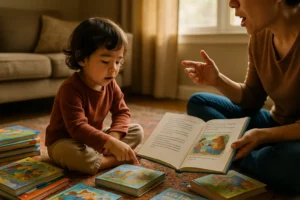
For families raising bilingual preschoolers, English-only Head Start raises a practical question: what might children lose if classroom language support shifts away from the home language? The answer is not simple, because Head Start classrooms vary by community, staffing, child population, and family language needs. Still, the current research and reporting point to real concerns for dual language learners, especially when policy changes affect classroom instruction, family communication, and children’s access to familiar language during early learning.
As of October 11, 2026, the policy discussed here had been reported as a proposed federal rule rather than a completed change. That distinction matters. Families and educators should avoid assuming that every local program has already changed practice. The more useful task is to understand the likely pressure points so families can ask informed questions and protect children’s language growth at home.
What English-only Head Start Would Change
Head Start has long served many children who are learning English while also developing a home language. KQED reported that about 35% to 40% of Head Start children are dual language learners, while only about one-third of staff are bilingual KQED reporting. That staffing gap means that even before any policy change, many programs already face limits in how much language-matched support they can provide.
English-only Head Start And Daily Classroom Language
The proposed shift matters because preschool language learning does not happen only during formal lessons. It happens during arrival, meals, conflict repair, pretend play, bathroom routines, book reading, and family handoff at pick-up. If a program is directed to use only English for classroom instruction, educators may have less room to connect new English words to concepts children already understand in Spanish or another home language.
For a child, that can change the feel of the school day. A familiar word from a teacher can help a preschooler understand a direction, join a game, or calm down after a hard moment. Removing that option does not automatically mean a child will stop learning English. It may mean the child has fewer bridges between what they already know and what the classroom is asking them to learn.
Family Materials And Trust
Research notes for this topic also described proposed changes that would remove requirements tied to staff who speak children’s home languages, translated family materials, and non-English classroom materials. The effect of those changes would likely differ by site. A center with many bilingual staff members and strong family relationships might manage the shift differently from a center with few bilingual adults and many newly enrolled families.
Families need clear information from schools in a language they understand. If translated materials disappear or become harder to obtain, parents may have more trouble understanding attendance expectations, child progress notes, classroom concerns, developmental referrals, or family events. That is not a small side issue. Family-school communication is part of how young children receive consistent support across home and preschool.
What The Evidence Says About Two-Language Growth
The strongest caution is that English growth and home-language growth should not be treated as opposites. A child can build English while still using and strengthening the home language. In fact, the research base described in the notes for this article points toward benefits from bilingual approaches, especially for children who enter preschool with developing skills in both languages.
A study of 471 Spanish-English dual language learners in Head Start followed children for two years and found that stronger home-language and English skills were associated with better socioemotional development dual language study. This finding does not prove that every bilingual classroom practice directly causes better social outcomes. It does support a careful view: both languages are part of the child’s developmental profile, and ignoring one language may leave educators with an incomplete picture.
Why Home Language Is Not A Distraction
Some adults worry that using the home language in preschool will slow English. The research summarized for this topic does not support a simple “more English only equals better English” assumption. In one experimental study included in the research notes, Spanish-speaking preschoolers in Head Start who received transitional bilingual education showed stronger growth in Spanish oral vocabulary and letter-word identification than peers in English-only instruction, with minimal negative impact on English outcomes.
That does not mean every bilingual program is equally effective. Quality still matters. Teachers need planned language support, meaningful vocabulary work, family communication, and developmentally appropriate interaction. But the available evidence gives families a reason to question policies that treat the home language as a barrier rather than a resource.
What We Still Do Not Know
There are limits to the evidence. Studies differ in design, child age, language pair, classroom model, and outcome measure. A finding from Spanish-English preschoolers may not apply in the same way to children speaking Arabic, Haitian Creole, Vietnamese, Mixtec, or another language. Local implementation also matters. A written policy can look different from what happens during a child’s morning circle time or a parent-teacher conversation.
That uncertainty should not be used to dismiss family concerns. It should push programs and policymakers to track what happens to attendance, family participation, vocabulary growth, classroom engagement, and children’s comfort after any major language-policy shift.
Practical Steps Families Can Take Now
If English-only Head Start rules affect a local program, families still have meaningful ways to support bilingual development. The home does not have to become English-only. Children benefit from warm, frequent, meaningful conversation in the language adults know best. A parent or grandparent who tells stories, explains routines, sings songs, and talks through feelings in the home language is giving the child language input that supports thinking, relationships, and identity.
- Ask the program specific questions. Families can ask whether teachers may use the home language for comfort, safety, clarification, or family communication.
- Keep home language routines steady. Shared meals, bedtime stories, songs, prayers, and family calls can all support vocabulary and connection.
- Share useful child words. A short list of words for bathroom needs, emotions, foods, and comfort items can help staff understand the child.
- Document communication barriers. If families cannot understand school notices or meetings, written notes can help clarify what support is missing.
For more family-centered ideas, this related resource on home language preschool support explains why home routines remain valuable even when classroom language policy changes. Readers who also follow local education and community coverage through the Wakefield Rep platform may recognize the same core issue: families need clear, practical information before policy changes reach daily life.
Program-Level Risks For Bilingual Learners
The possible consequences are not only academic. Young children use language to ask for help, enter play, explain fear, resolve conflict, and show what they know. If a child cannot yet do those things easily in English, the classroom may underestimate the child’s ability or misread silence as lack of knowledge.
Programs may also face practical costs. Research notes for this topic included estimates connected to replacing classroom materials, retraining staff, and addressing staffing needs. Cost estimates should be read with care because they depend on assumptions about how many classrooms must change materials, what training is required, and whether programs can retain bilingual staff. Still, large implementation costs would compete with other needs in early-childhood programs, including staffing stability, family services, and classroom quality.
Another risk is a weaker connection with families. If parents feel that their language is unwelcome, they may hesitate to ask questions or share concerns. That would be a harmful outcome for any preschool system, because educators need family knowledge to understand a child’s speech, behavior, health, and daily stressors.
English-only Head Start And Bilingual Learners
The strongest evidence-based position is not that every classroom must look identical. It is that bilingual learners should not be asked to set aside a major part of their language development to prove they are ready for school. English matters for kindergarten access in many communities, but the home language also carries vocabulary, family relationships, emotional expression, and early knowledge.
English-only Head Start policies may be presented as a direct path to English learning, yet the research summarized here does not show that removing home-language supports is the best way to build strong English skills. A safer approach for children is one that treats both languages as useful, watches outcomes carefully, and keeps family communication clear.
For parents, the practical message is steady and hopeful: keep talking, reading, singing, and explaining in the language that lets you be most responsive. For programs, the responsibility is equally clear: measure the effects of any language-policy change on real children, not just on compliance paperwork.