Trying to teach communication skills through boring repetition is like trying to teach a goldfish to play chess. It’s not just ineffective – it’s neurologically misguided.
Our brains aren’t wired for dry drills. They crave story, game, and the delicious friction of problem-solving. That’s why speech therapists use dynamic methods that feel more like play than work.
Language forms the bedrock of early learning, and research shows that active engagement creates the neural pathways that stick. When we transform from frustrated instructors to delighted play partners, everything changes.
The American Academy of Pediatrics confirms that play supports language development by helping children decipher meaning in varied contexts. It’s not just more fun – it’s smarter learning.
This approach to speech development at home turns everyday moments into rich learning opportunities. The magic happens not in sterile laboratories of flashcards, but in the wild playground of imagination.
Everyday Activities with Purpose
The secret to growing your language skills isn’t in flashcards. It’s in the everyday moments we often overlook. You don’t need a degree to make daily routines into home language activities that work.
I Spy is more than a game to pass the time. It’s a way to learn new words and describe things while you’re stuck in traffic. It’s like getting a free lesson in linguistics.
Scavenger hunts are more than fun. They teach kids to follow directions and think spatially. Kids learn better problem-solving skills than with worksheets.

Hopscotch Word Fun turns sidewalk chalk into a way to learn new words. Each square is a new category – animals, foods, emotions. Kids think it’s just fun, not learning.
The Alphabet Game during car rides turns license plates into reading practice. It’s like a mobile classroom that’s fun. Every truck is a chance to spot a new letter.
The Bury Objects game mixes archaeology with learning new words. Kids describe what they find in sand or rice. It’s hands-on learning that’s better than any list.
Bedtime stories become interactive with “what happens next?” questions. These questions build prediction skills. Puppet story retelling lets kids direct their own stories.
Charades turns your living room into a stage for verb practice. Picture description during commercials is a quick vocabulary drill. Drawing your own ending makes watching TV a creative activity.
Seeing language activities in daily life changes everything. Meal prep is adjective practice. Walking the dog is preposition practice.
It’s about seeing daily activities as language practice. Your home is full of home language activities. You just need to see them differently.
Structured vs. Unstructured Play
If language development were a kitchen, structured activities would be like recipes. Unstructured play would be like cooking with whatever you have. Both are important but in different ways.
Structured play is like a Michelin-starred kitchen. Every step is planned. Word Search puzzles and the Articulation Station App are examples. They help build specific language skills step by step.
Unstructured play is like making a midnight snack. It’s about using what you have. Hide-and-Seek with Words and alphabet art projects are examples. They help discover language in a fun way.
The best learning happens when we mix both. Some families might think one way is better than the other. But the truth is, it’s about knowing when to guide and when to let go.
| Activity Type | Examples | Primary Benefits |
|---|---|---|
| Structured Play | Word Search, articulation apps, gap-fill exercises | Targeted skill development, measurable progress, systematic learning |
| Unstructured Play | Hide-and-Seek with Words, alphabet art, round-robin discussions | Creative application, contextual learning, emotional engagement |
| Hybrid Approach | Sensory writing trays, story card sequencing | Balanced development, adaptive learning, sustained interest |
Sensory writing trays and story cards are great examples of mixing both. They guide but also let creativity shine. This mix often leads to the biggest breakthroughs in learning.
The key is finding the right balance. Some days, we need structure. Other days, we need to let language flow freely. It’s all about knowing when to guide and when to let go.
Parents often wonder about the perfect balance. I say it’s like finding the right spice blend. It depends on the situation and the child. The best learning strategies are flexible and adapt to each child’s needs.
Tracking Progress
Tracking language growth might seem dull, like watching grass grow. But it’s actually key to speech development at home. Without it, we’re just guessing at how much our kids are improving.
Think of that scene in The Matrix where Neo sees the code. That’s what tracking does – it uncovers hidden patterns. Today’s tools make tracking feel more like a part of life, not a chore.
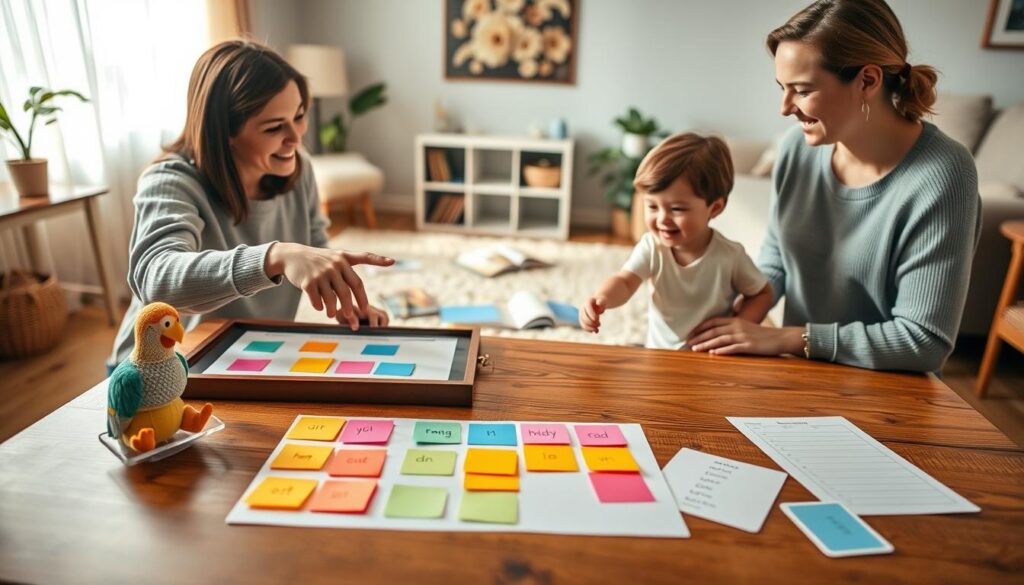
Families are turning dinner into a chance to track progress. They record videos each month where kids share their favorite stories. It’s amazing to see how much they improve, like how they say “spaghetti” better over time.
Apps like Articulation Station make practicing pronunciation fun and rewarding. Tools like Sanako Connect give instant feedback, making it feel less formal.
Tracking should be seamless, like noticing a child’s spontaneous rhyme. It’s about observing, not testing. Save those moments when your child uses complex sentences during play.
| Tracking Method | What It Measures | Why It Works |
|---|---|---|
| Video Journals | Fluency & storytelling progression | Shows visible, audible growth over time |
| Digital Portfolio | Vocabulary expansion & creativity | Creates tangible evidence of development |
| App-Based Tracking | Pronunciation accuracy | Provides objective data without pressure |
| Conversation Recording | Sentence complexity & spontaneity | Captures natural language in real contexts |
The goal is to track what really matters. It’s not just about mastering words, but gaining confidence. It’s about expressing ideas, not just sentences. That’s where language development truly happens.
Your tracking progress system should feel like an extension of play. It should guide your journey without feeling like you’re following rules.
Integrating Activities into Daily Routines
Let’s face it, we’re all busy and don’t need more things to do. The trick is to blend language learning into our daily lives without even noticing. It should be as natural as breathing.
Start your day by talking about the sounds of breakfast. On the way to school, play games with license plates and signs. Bedtime can turn into a fun time for making up stories and rhymes.
The aim is to make every moment a chance to learn language. Families find themselves enjoying every interaction, not stressing about it. They start to see language learning in every conversation.
Using technology wisely is key. Apps during car rides or video calls can help with reading and writing. But remember, it’s about using it smartly, not just for entertainment.
| Daily Routine | Language Opportunity | Effort Level | Impact |
|---|---|---|---|
| Morning meals | Descriptive food vocabulary | Low | High |
| Car rides | Sign reading, storytelling | Medium | Medium-High |
| Neighborhood walks | Environmental vocabulary | Low | Medium |
| Bedtime routines | Narrative building, rhyming | Medium | High |
The best home language activities are already part of your life. They’re in your daily routines. Just start seeing them and you’ll be amazed at how easy it is.
Top Resources
Forget expensive curricula. The best language tools are often free. Sensory writing trays make spelling a fun adventure. Playdough lets you sculpt the alphabet in 3D.
Alphabet scavenger hunts turn your living room into a treasure hunt. These low-tech wonders make learning feel like play, not homework.
We’re not against technology. When used right, it brings us closer. Articulation Station turns practice into games. Heads Up! makes learning vocabulary fun at family game night.
Sanako Connect and digital journaling tools give instant feedback. They support, not replace, real conversations. This balance is key.
The University of St. Augustine’s MS-SLP program teaches this balance. Educational apps work with old-fashioned conversation. It’s not about screen time versus real time. It’s about using both wisely.
Your best resource is the time you spend together. These tools just set the stage. The real magic is in the connection you make through language. Now go play – your words are waiting.