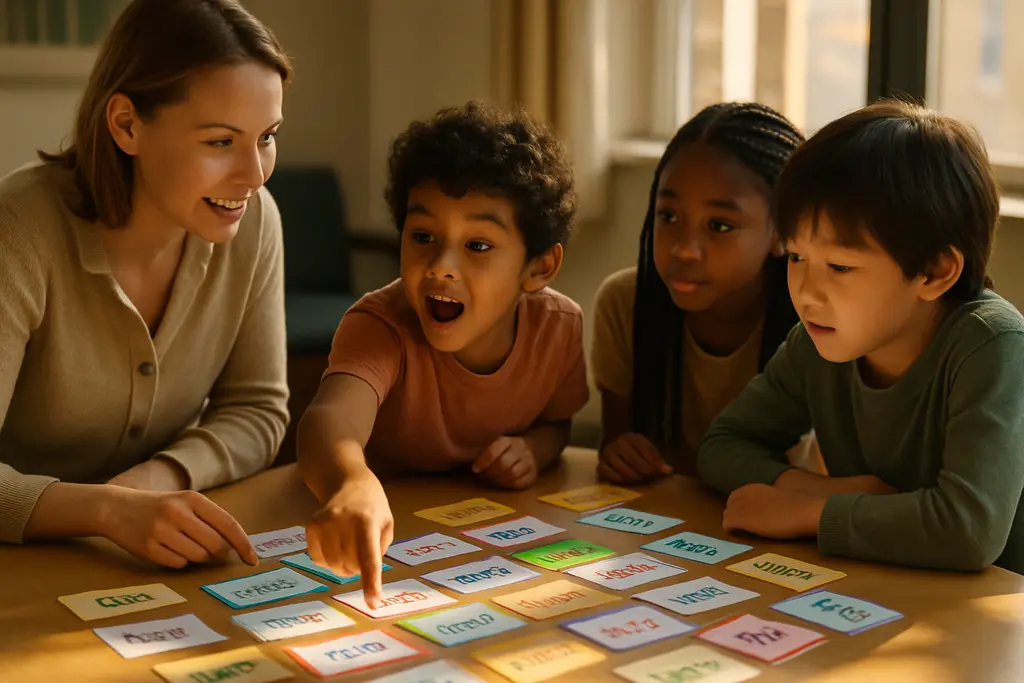
Effective multilingual vocabulary activities should help children connect new words to meaning, use those words in real interaction, and keep access to all of their language resources. The research base is encouraging, but it also asks adults to be precise: children often improve most on the exact words they are taught, while broader vocabulary growth may need time, repeated exposure, and use across settings.
For families, educators, and speech-language teams, that means vocabulary practice should not be reduced to flashcards or isolated naming drills. Young learners usually need adults to explain words clearly, show words in meaningful contexts, invite responses, and revisit the same vocabulary during books, play, science talk, drawing, and daily routines. For related age-specific examples, families can compare these ideas with bilingual vocabulary activities for ages 4 to 6.
Why Multilingual Vocabulary Activities Need Clear Targets
Choosing Multilingual Vocabulary Activities With Specific Words
The clearest evidence for early second-language vocabulary teaching comes from interventions that identify target words and teach them intentionally. A review of vocabulary interventions for second-language learners up to age six included 12 studies with 1,943 participants and found large immediate effects for taught receptive vocabulary and taught expressive vocabulary compared with standard care vocabulary intervention review.
This finding supports a practical starting point: pick a small set of useful words before the activity begins. The words should be worth knowing, connected to the child’s current book, classroom topic, family routine, or therapy goal, and possible to use more than once. For example, during a water play activity, adults might choose pour, full, empty, float, sink, and splash rather than introducing many unrelated labels.
Why Taught And Untaught Words May Grow Differently
The same review found stronger effects for words that were directly taught than for broader, untaught vocabulary or wider comprehension outcomes. That distinction matters. If a child learns six new science words after two weeks of planned teaching, that is useful progress. It does not prove that the child’s full vocabulary system has changed at the same pace.
The strongest multilingual vocabulary activities make this limitation visible instead of hiding it. Adults can track taught words, listen for spontaneous use, and ask whether the child understands related words that were not practiced directly. This protects children from being overtested and protects adults from assuming that one successful lesson means vocabulary growth has generalized everywhere.
Classroom And Home Activities That Build Word Meaning
Shared Reading With Repeated Target Words
Shared book reading is a natural place for vocabulary growth because it gives adults and children a shared topic. The adult can introduce a word before reading, pause when the idea appears, and return to the word after the page or story. A child does not need to define every word perfectly to benefit. Pointing, choosing between pictures, acting out a meaning, or using a home-language equivalent can all show that the child is building understanding.
During a book about gardens, an adult might say, The seed is tiny. Tiny means very small. Show me something tiny on this page. Later, during snack, the adult might notice a tiny crumb. During outdoor play, the child might find a tiny rock. These repeated, meaningful moments help the word become useful rather than only remembered for a single page.
Word Maps, Examples, And Child-Friendly Use
Word maps can help multilingual learners because they organize meaning in more than one way. A word map can include a child-friendly explanation, a drawing, a gesture, examples, non-examples, a sentence frame, and related words in another language when appropriate. For young children, the map should stay simple and interactive.
- Say the word clearly: Use natural speech and let the child hear the word more than once.
- Explain the meaning: Use familiar language rather than a dictionary-style definition.
- Show examples: Use objects, pictures, actions, or pages from a book.
- Contrast non-examples: If teaching rough, compare a rough rock with a smooth cup.
- Invite use: Ask the child to choose, describe, act, draw, or complete a sentence.
Well-planned multilingual vocabulary activities also leave room for partial answers. A child might first point to the correct object, then say one word, then later produce a short phrase. Those steps can all be meaningful, especially for children who are building vocabulary across more than one language.
Using More Than One Language As A Resource
Home Language Links And Related Words
Multilingual children do not arrive at a lesson as blank slates. They may already know a concept in one language before they learn the school-language word for it. If a child knows the meaning of cold in a home language, adults can connect that known concept to cold in English or another instructional language. The goal is not to replace the home language. The goal is to connect meaning across the child’s full language experience.
Some words across languages may sound or look related, while others may not. Adults can notice similarities when they are real and avoid forcing false connections. They can also compare word parts, such as plural endings, prefixes, or word families, in an age-appropriate way. For a preschooler, this might be as simple as saying, These two words both talk about counting more than one. For an older child, it may include academic word parts used in science or reading.
Practice Across People, Places, And Routines
Vocabulary is more useful when children hear and use words with different people. A teacher might introduce observe during a science lesson. A parent might use observe while watching birds from a window. A speech-language pathologist might practice observe with picture description. These different uses help a child learn that the word is not tied to only one worksheet or one adult.
For multilingual vocabulary activities, adults can plan a simple bridge between settings. If school sends home three target words, families can use whichever language supports meaning best, then add the school-language word during the routine. If the child responds in the home language, adults can accept the meaning and model the new word rather than treating the first response as wrong.
What Digital Tools Can And Cannot Add
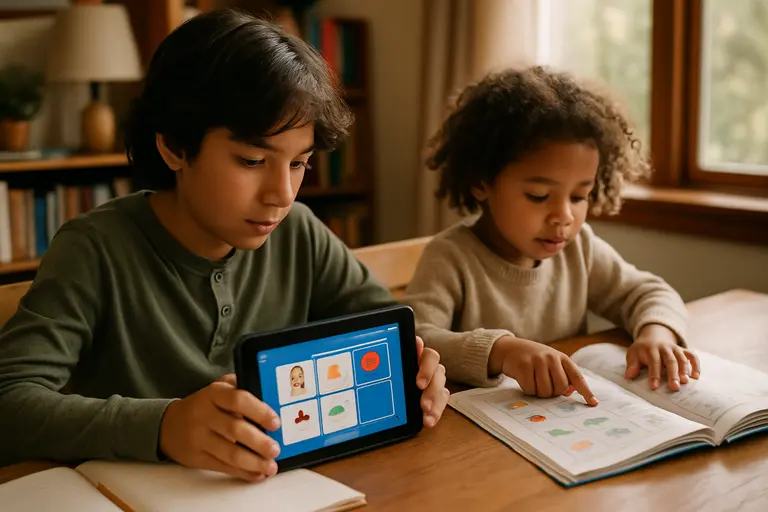
AI Pre-Teaching For Older Children
Digital tools may help some learners practice words before a classroom lesson, but the evidence should be read carefully. A Macquarie University record for a working paper submitted on July 17, 2026 described Grades 2 to 4 EAL/D students in Sydney who learned 12 academic science words through an AI web app across six at-home sessions over two weeks. The report found a large effect for trained words compared with untrained words and a smaller effect for comprehension accuracy in lessons using pre-taught vocabulary AI vocabulary learning paper.
That is promising, but it is not proof that AI tools work for every child, every age group, or every vocabulary goal. The study context involved older elementary students, academic science words, a short intervention period, and a specific web app. Preschoolers, children with speech-language disorders, and children using AAC may need different supports and closer adult mediation.
Keeping Adults In The Interaction
Technology should not remove the adult’s role in noticing meaning, emotion, attention, and participation. Children may click the right answer without being ready to use the word in conversation. They may also understand a concept but struggle to say the new word aloud. Adults can respond by modeling, expanding, and offering another way to answer.
Programs that coordinate teachers, assistants, tutors, or therapy staff also need clear communication about who is teaching which words and how progress is being observed. One example of a related site in the same network is Alliance Recruitment, which primarily deals with workforce topics; however, in child language support contexts, it emphasizes the importance of adults having shared expectations and consistent response styles.
Effective Language Activities For Multilingual Learners
What To Watch During Vocabulary Practice
Progress is not limited to a child saying a perfect word on request. Adults can watch for understanding, participation, and flexible use. A child may show growth by pointing to the correct picture, using a gesture, choosing between examples, using the word in one language, repeating part of a phrase, or applying the word in a new routine. These small signs help adults adjust support without turning every activity into a test.
- Receptive understanding: Does the child point, act, match, or choose in a way that shows meaning?
- Expressive use: Does the child say, sign, select, or approximate the word during interaction?
- Use across contexts: Does the word appear beyond the original book, app, or lesson?
- Home-language connection: Can the child show the concept in either language?
- Need for support: Does the child need a model, choice, visual cue, or wait time?
A Practical Planning Pattern
For multilingual vocabulary activities, a simple planning pattern is often enough: choose a few meaningful words, teach them in context, connect them to known concepts, revisit them across routines, and record what the child can do with support and without support. This pattern fits shared reading, pretend play, cooking, outdoor observation, classroom science, storytelling, and digital pre-teaching.
The evidence supports intentional vocabulary teaching, especially for directly taught words. It also reminds us to be cautious about broad claims. A short activity can introduce a word, but children usually need repeated, meaningful chances to understand and use that word with real people. For multilingual learners, the most supportive activities respect the child’s full language knowledge while giving clear access to the words needed for school, relationships, and daily communication.