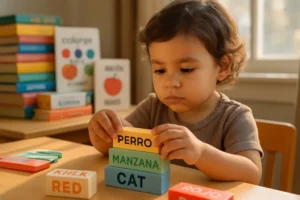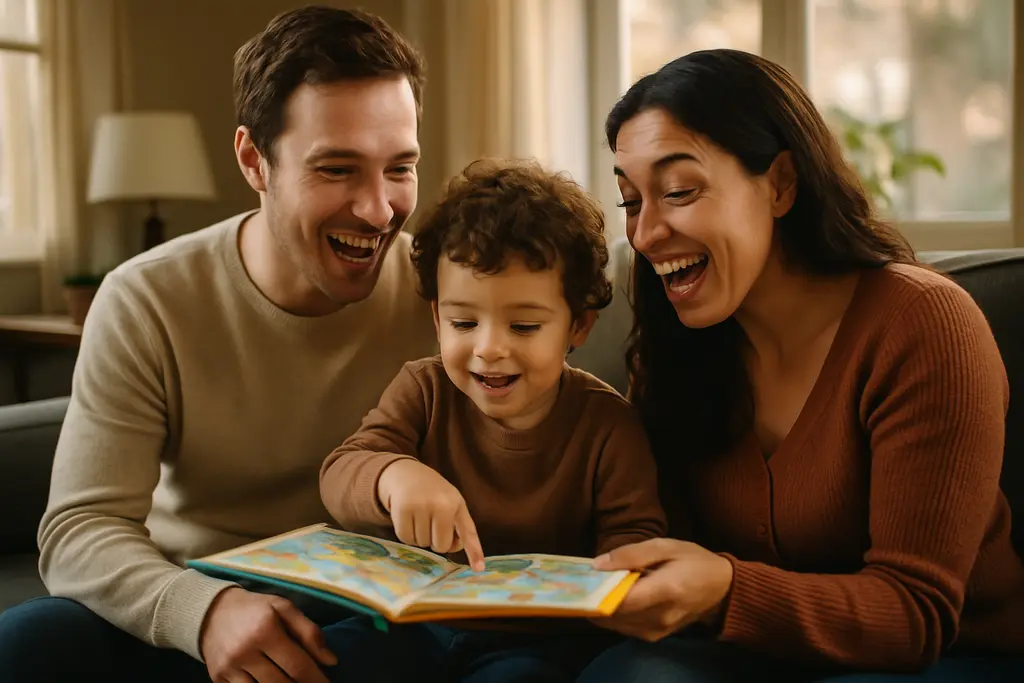
For bilingual preschoolers, family engagement practices can connect what children hear in early childhood classrooms with the languages, stories, and relationships they live with at home. The evidence does not say that one family routine works for every child. It does show that home language activities, shared reading, storytelling, and caregiver-school partnerships can support bilingual development when they are used in ways that respect the child’s full language experience.
That matters because many families are told, directly or indirectly, that English should take priority once school begins. Research on dual language learners points in a more balanced direction: children can benefit when early education supports English growth while also keeping the home language active. For parents who want practical examples beyond school worksheets, this related article on bilingual home language support explains why everyday interaction often matters more than translation drills.
Why Family Engagement Practices Matter
Family Engagement Practices And Home Language
The strongest family-school work starts with a simple assumption: a child’s home language is not a problem to solve. It is part of the child’s knowledge base. In bilingual early childhood education, that means parents and educators can treat Spanish, Mandarin, Arabic, Haitian Creole, or any other home language as a resource for thinking, storytelling, vocabulary, and family connection.
In practical terms, family engagement can include parent-child reading, oral storytelling, songs, conversations during meals, naming and describing objects during chores, and talking about events that happened during the day. These are not separate from learning. They are the kinds of repeated, meaningful language experiences young children use to connect words with people, actions, feelings, and ideas.
For bilingual children, the value is not limited to matching the classroom language. A caregiver who tells a story in the language they use most naturally can offer longer sentences, clearer explanations, humor, cultural references, and emotional warmth. Those features are difficult to reproduce if adults feel pressured to use a language in which they are less confident.
What Counts As Engagement
Engagement does not have to mean attending every school event or completing every take-home activity. Some families work changing schedules, share housing, care for younger children, or have limited transportation. A fair approach gives families several ways to participate: sending a voice note in the home language, sharing a favorite song, reading a short book together, telling the teacher which words the child uses at home, or describing routines that matter to the child.
Community connections can also support families looking for child-centered activities and language-rich interaction outside the classroom. For readers exploring related youth and family resources in the same network, Stuyvesant Youth Community may serve as a helpful resource.
What Recent Head Start Evidence Shows
Spanish Vocabulary Gains In Context
A study published in Early Childhood Education Journal in September 2023 examined Head Start preschoolers receiving Spanish-English dual language instruction. The study found that when caregivers carried out extra Spanish family engagement activities, children showed significant gains in Spanish vocabulary beyond classroom effects, according to the Springer Nature study.
This finding is useful because it separates two parts of the child’s experience: what happens in the classroom and what families can add at home. It does not mean that every child will gain at the same pace, or that Spanish activities alone are enough for full bilingual development. It does suggest that home-language engagement can add measurable support rather than merely preserve culture in a symbolic way.
For Spanish-English programs, this evidence supports a practical message for families: using Spanish at home is not a setback for school readiness. Carefully chosen Spanish activities can support vocabulary growth while the classroom continues to provide English and dual-language learning opportunities.
Family Literacy Pathways
A 2026 analysis using data from the Head Start Impact Study found that family literacy engagement helped explain part of Head Start’s effect on early literacy. Parent-child reading, storytelling, and related practices mediated 12.4% of Head Start’s effect on vocabulary and 10.7% of its effect on decoding skills, with especially strong effects for dual language learners, according to the Early Childhood Research Quarterly analysis.
Those percentages should be read carefully. Mediation findings do not prove that a single home activity directly caused every later skill. They do show that family literacy engagement was part of the pathway through which Head Start was linked with stronger early literacy outcomes. For teachers and parents, that is a reason to design family activities that are realistic, repeatable, and connected to classroom goals.
The research base also has limits. Much of the evidence discussed here comes from Head Start settings and, in one key study, Spanish-English dual-language instruction. Families using other language pairs, living in different communities, or participating in different preschool models may need support that looks different.
What Families Can Do Without Turning Home Into School
Use The Stronger Language For Real Conversation
Many parents ask whether they should speak English at home to prepare a child for school. If English is not the caregiver’s strongest language, forcing English-only interaction can reduce the amount and quality of talk. A more supportive plan is to use the language that allows the adult to explain, joke, comfort, ask questions, and tell stories naturally.
That kind of interaction can happen during regular routines. A caregiver can describe ingredients while cooking, compare clean and dirty clothes during laundry, talk about who came to visit, or ask the child what happened first and next in a story. These ordinary exchanges give children practice with vocabulary, sequencing, memory, and conversational turn-taking.
- Tell a short family story and ask the child to add one detail.
- Read a familiar book and pause for the child to predict what happens next.
- Use home-language words for feelings, actions, colors, locations, and people.
- Invite grandparents or siblings to share songs, sayings, or stories in the home language.
Keep Books And Stories Interactive
Shared reading does not require a large home library. A caregiver can talk through a library book, a classroom book bag, a family photo, or a child’s drawing. The key is interaction. Instead of asking only “What is this?” adults can ask open questions, expand the child’s answer, and connect the story to real life.
For example, if a child says, “dog,” the adult might answer, “Yes, the dog is wet because it ran in the rain.” In Spanish, the same kind of expansion might build grammar, descriptive words, and cause-and-effect language. The exact language matters less than the quality of the exchange and the child’s chance to participate.
This is where family engagement practices should stay humane. A tired parent reading for five warm minutes may create a better language experience than a long worksheet session filled with correction. Young children need repetition, but they also need relationships that make communication worth using.
How Educators Can Build Trust With Bilingual Families
Ask Before Advising
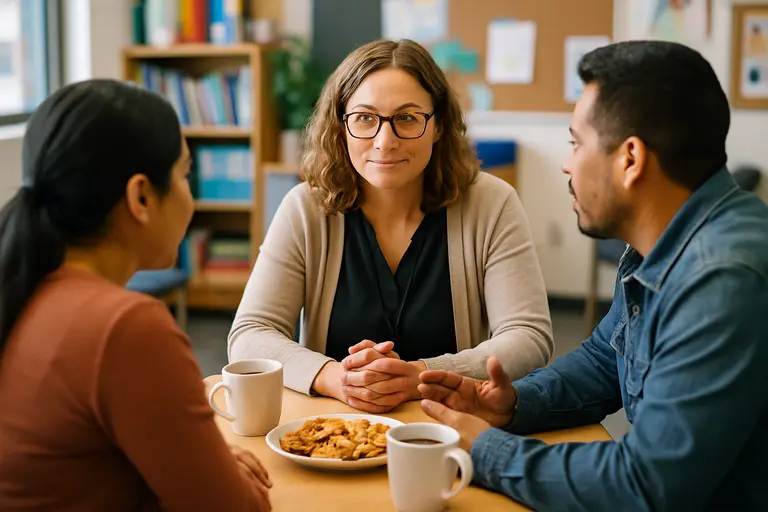
Educators often want to help quickly, but bilingual family support works better when teachers first ask what the child already hears and uses. Questions might include: Which language does your child use with each family member? What songs or stories does your child like? Are there words your child says at home that we may not recognize at school?
Answers to those questions can help teachers understand the child’s full communication profile. A child who is quiet in English at school may be talkative in another language at home. That does not remove the need to monitor speech and language milestones, but it prevents adults from judging the child’s ability based on only one setting or one language.
Send Home Activities That Fit Real Life
Teachers can support family engagement practices by offering short, flexible activities rather than long packets. A note might say, “Tell your child a story about a time you helped someone,” or “Ask your child to name three things they see on the walk home.” Families can do these in the home language, English, or both.
Schools should also be cautious about assuming that all parents are comfortable reading printed materials in either language. Oral storytelling, picture talk, and conversation prompts can include caregivers who have different literacy levels, different schooling histories, or limited time.
Family Engagement Practices In Early Childhood Education
Family engagement practices support bilingual development best when they strengthen the connection between home and school without asking families to give up the language that holds daily life together. The most defensible message from recent research is not that parents must become teachers. It is that children benefit when families are invited into language learning through routines they can actually sustain.
For parents, that may mean reading, telling stories, singing, describing chores, and talking in the language that feels most natural. For educators, it means treating home languages as learning assets, offering flexible activities, and interpreting children’s skills across both home and school contexts.
The evidence is promising, but it is not one-size-fits-all. Program design, language pair, family schedule, caregiver confidence, and classroom quality all affect what support looks like. Still, the central lesson is clear enough for action: bilingual children need frequent, meaningful language with people who know them well. Strong school programs matter, and so does the talk, story, and connection that continue after the school day ends.