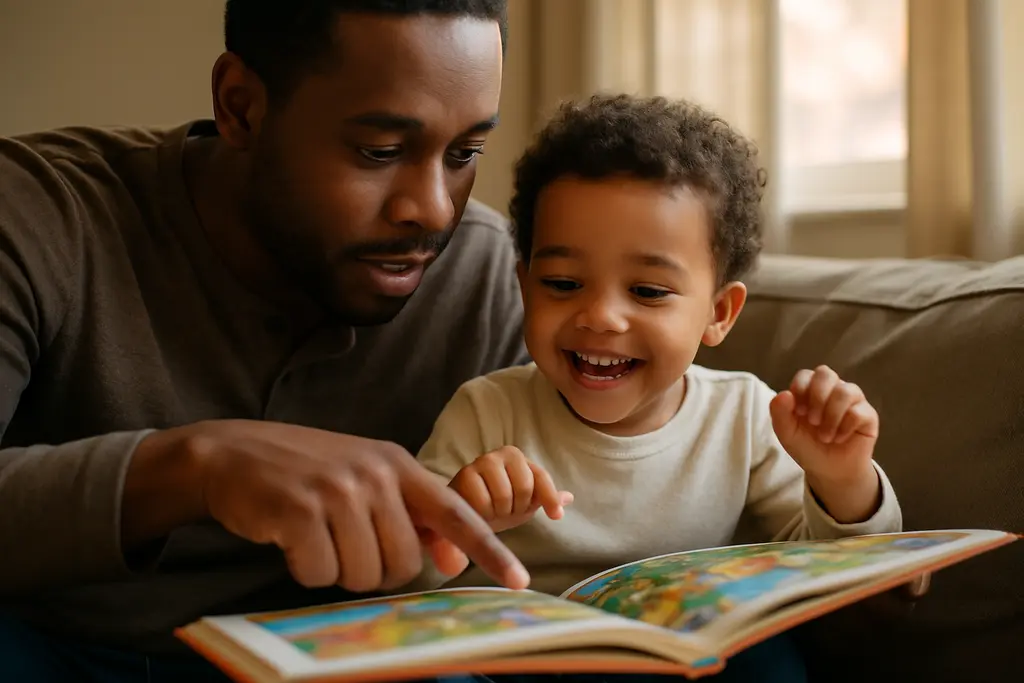

For young children, structured conversation during shared reading means more than asking, “What color is this?” It is a planned but warm exchange in which an adult invites a child to notice, predict, explain, connect ideas, and retell parts of a story. This kind of talk is often discussed in research as dialogic reading: the adult does not simply read aloud while the child listens, but uses the book as a shared space for language, thinking, and early literacy practice.
That matters because early literacy is not only about recognizing letters. Children also build vocabulary, story understanding, listening comprehension, narrative skill, and the confidence to express ideas. These oral language foundations can support later reading, though no single routine guarantees a specific outcome for every child. The research base is encouraging, but it also shows variation by age, measurement method, and the quality of adult-child interaction.
Why Structured Conversation Supports Early Literacy
Structured Conversation During Shared Reading
In structured conversation, the adult uses prompts and follow-up comments to keep the child mentally active. A page showing a character holding an umbrella might lead to questions such as, “Why do you think she brought that?” or “What might happen if the rain stops?” The adult then expands the child’s answer: “Yes, she may close the umbrella because the sky is clearing.”
This pattern gives children practice with vocabulary, cause-and-effect language, story sequence, and inferencing. It also gives adults a clearer view of what a child understands. A child who can label “dog” may still need support explaining what the dog is doing, why it ran away, or how a character feels. Those deeper responses are part of the bridge between conversation and comprehension.
What Children Practice When Adults Pause
Pausing is one of the most practical tools adults have. A short wait after a question gives the child time to think, gesture, point, use a home language word, or give a partial response. The adult can then build on that response without turning the moment into a test.
Useful book talk often includes repeating key words, adding one new word, connecting the story to the child’s life, and inviting the child to retell a small part. Parents and educators who want more home-based ideas can pair this approach with broader oral language routines that use shared reading, questions, and vocabulary practice in everyday settings.
What The Research Suggests And What It Cannot Prove
Findings With Preschool And Early Grades
A 2026 meta-analysis covering studies from 2000 to 2025 reported that dialogic reading had a large effect on reading literacy across preschool through grade 6 samples. The effects described in the research were especially strong for decoding and comprehension, with smaller but still meaningful effects for response measures. Motivation showed very large gains in that analysis, but those results were described as less consistent.
Research with preschoolers has also linked dialogic reading to gains in narrative skills. A 2026 systematic review of quasi-experimental and experimental studies reported improvements in narrative macrostructure and causal language reasoning. These areas matter because children need to organize events, explain why things happen, and understand how story parts connect.
Parent involvement is one promising part of the evidence. In a six-week parent-focused dialogic book reading intervention with Italian preschoolers, treatment groups showed sustained gains on oral language and literacy tasks, and parents increased dialogic reading behaviors during shared book reading, according to the PubMed abstract.
Why Results Vary
The evidence does not mean every child will make the same amount of progress from the same routine. The 2000–2025 meta-analysis noted smaller effects for younger children and when outcomes were measured with standardized tests. That is a useful caution. Younger children may be building the attention, memory, and expressive language needed to benefit from longer exchanges. Standardized measures may also capture broader reading skills differently than activities closely matched to an intervention.
Longer curriculum-based work shows a more modest pattern. Reports on early childhood programs that integrated interactive reading and related activities over seven to eight months, including Head Start REDI, described vocabulary and language-use home effects in the range of about 0.15 to 0.25, as summarized by ASPE school readiness proceedings. Those smaller effects are still relevant, especially at scale, but they remind us not to promise dramatic change from one practice alone.
How Adults Can Use Book Talk Without Turning It Into A Quiz
Prompts That Invite Longer Talk
Book conversations work best when they feel like shared thinking. A child should not need to answer perfectly before the story continues. The goal is participation: a word, a gesture, a sound effect, a short explanation, or a personal connection can all be meaningful.
- Ask open questions: “What do you think he will do next?”
- Follow the child’s interest: If the child points to the truck, talk about the truck before moving on.
- Expand gently: If the child says “baby cry,” the adult might say, “The baby is crying because the toy broke.”
- Connect to experience: “Remember when we wore boots in the rain?”
- Invite retelling: “Tell Grandma what happened to the bear.”
A practical rhythm is prompt, wait, respond, and extend. This rhythm gives the child a real turn. It also keeps the adult from filling every pause, which can accidentally reduce the child’s chance to contribute.
What To Avoid
Too many rapid questions can make reading feel like an oral exam. Children may begin to guess what the adult wants rather than think about the story. Repeated correction can have the same effect. If a child says, “Him goed home,” an adult can model the grammar naturally: “Yes, he went home after the party.”
Adults should also be careful not to judge progress only by spoken answers. Some children show understanding by pointing, acting out a scene, choosing between pictures, using a communication device, or answering in another language. The adult’s response should show that those forms of communication count.
Supporting Different Learners And Home Languages

Bilingual And Varied Communication Needs
Children who use more than one language can benefit from story talk that respects all of their language resources. If a child answers partly in a home language, the adult can acknowledge the idea and, when helpful, offer the word in the school language too. The aim is not to replace one language with another, but to help the child connect meaning across settings.
For children with speech delays, limited speech, or AAC systems, book talk may need more wait time and different response options. An adult might offer two picture choices, model a phrase on a communication device, or invite the child to point to the character who feels scared. The same principle applies: the child needs a real way to contribute.
Family Routines
Families do not need special materials to begin. A familiar picture book, a library book, a wordless book, or a family photo album can support meaningful talk. For teams creating family handouts or home activity pages, related network resources such as Finest Image can provide valuable supplements to literacy planning tools, enhancing the adult-child exchange around shared meaning.
Short, repeated routines are often easier to sustain than long lessons. A family might choose one bedtime book and use the same three prompts several times a week: “What do you see?” “Why did that happen?” and “What would you do?” Repetition can make children more confident because they know how the conversation works.
Structured Conversation In Everyday Early Literacy
A Practical Check For Progress
A small structured conversation can be useful when adults notice change over time. Progress may look like a child using a new word, giving a longer explanation, asking a question, retelling events in better order, or showing more interest in books. It may also look like a quieter child pointing more often or staying engaged for one more page.
Adults can keep expectations realistic by asking three questions after a week or two of shared reading: Is the child participating more often? Are the adult’s prompts helping the child say or show more? Is reading still pleasant? If the answer to the third question is no, the routine may need fewer questions, more playful comments, shorter books, or more choice from the child.
The strongest use of book talk is not a script delivered the same way to every child. It is a responsive routine grounded in evidence and adjusted to the child in front of us. Used with warmth, patience, and realistic expectations, structured conversation can help early literacy grow through the everyday pleasure of reading together.