A child may know what they want to communicate yet hesitate when every conversation feels like a test. Play-based language activities change that pressure by giving words, gestures, sounds, and facial expressions an immediate purpose inside something the child already wants to do.
The goal is not to disguise a worksheet as a game. Effective play creates a responsive exchange in which the child’s choices influence the story, the adult notices those choices, and communication becomes useful rather than performative.
Play-Based Language Activities Work Through Reciprocity
A shelf full of educational toys does not automatically create language growth. The crucial element is the interaction between the child and the adult.
Harvard’s serve-and-return framework describes responsive exchanges in which a child offers a sound, gesture, expression, or action and a caring adult responds. Play creates repeated opportunities for this pattern.
A child rolls a ball. The adult rolls it back and says, “Back to you.” The child hides an animal. The adult looks surprised and asks, “Where did it go?” Each response recognizes the child’s idea and opens another turn.
Adults should resist filling every silence. Waiting gives children time to process what happened, decide what they want, and choose how to respond. A pause is an invitation, not an empty moment.
Adults can create more turns by offering choices rather than asking open-ended questions the child cannot yet answer. Holding up two objects and waiting makes the communication demand clear while still allowing a gesture, look, sound, or word.
Waiting may initially feel unnatural, especially when an adult is eager to help. However, answering too quickly or moving the toy before the child responds can quietly take control of the interaction.
Play Creates a Real Reason to Communicate
Children communicate more readily when something meaningful depends on their response. A toy car cannot enter the garage until the child opens the door. A puppet needs help finding its hat. A block tower falls, and someone must decide what happens next.
These moments naturally invite requesting, commenting, protesting, predicting, and problem-solving. The child is not speaking simply because an adult asked for a word. Communication changes the play.
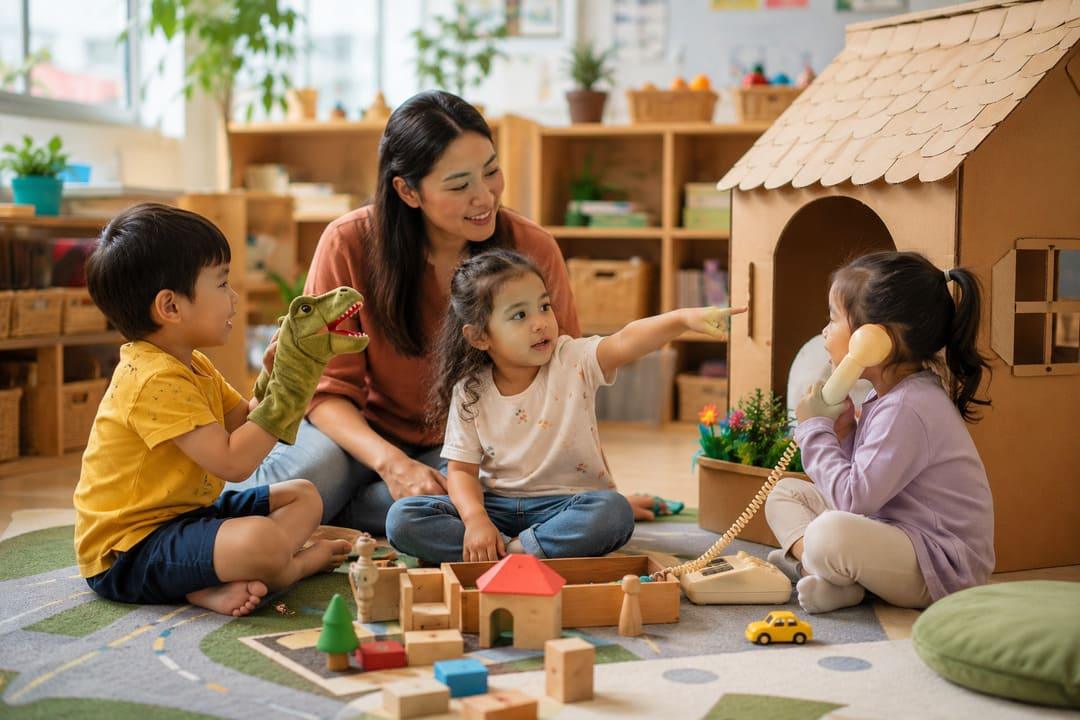
Shared play also accommodates more than spoken language. A child may point, move an object, imitate a sound, look toward a caregiver, or use a partial word. Guidance on shared play and communication emphasizes that back-and-forth interaction can happen through words or body language.
Communication confidence begins with being understood. Adults can acknowledge the child’s message first, then model a slightly clearer or longer version without requiring immediate repetition.
If a child points to a truck and says “go,” the adult might respond, “Yes, the truck is going fast,” before continuing the activity. This protects the child’s original meaning while offering useful language in a natural context.
Confidence Grows When Adults Follow Instead of Test
Many adults enter play with useful intentions but ask so many questions that the interaction begins to resemble an assessment. “What color is this?” “What is the animal called?” “How many blocks are there?” Questions can support language, but a rapid series may reduce initiative.
Comments often create less pressure. Instead of asking, “What is the dog doing?” an adult might say, “That dog is running fast,” then wait. The child can respond by copying a word, adding an idea, moving the dog, or changing the story.
Following the child’s focus also matters. If the child wants to spin the wheels of a truck rather than drive it, the adult can talk about “round,” “fast,” “stop,” and “again.” Language practice does not require redirecting the child toward the adult’s preferred version of play.
Specific activities such as puppet play ideas can also give hesitant communicators emotional distance. A child may find it easier to let a puppet ask for help, make a mistake, or speak to another character.
Pretend play can also make difficult emotions easier to approach. A toy bear may feel nervous about joining a game, while a rabbit becomes upset when another character takes its food. The child can explore possible responses without being asked to describe a personal experience.
This emotional distance can support perspective-taking, flexible thinking, and the language used to repair small social problems. Adults can enter the child’s story and introduce one manageable challenge without taking over the entire activity.
Everyday Games Can Target Different Communication Skills
Families do not need specialized materials or lengthy sessions. Familiar objects can support several communication goals when adults adjust the play without taking control.
| Play Activity | Adult Strategy | Communication Opportunity |
|---|---|---|
| Building blocks | Offer two pieces and wait | Choosing and requesting |
| Pretend kitchen | Create a missing-item problem | Asking for help |
| Toy animals | Give characters different feelings | Emotion language and perspective |
| Ball play | Pause before returning the ball | Turn-taking and anticipation |
| Dress-up play | Let the child assign roles | Planning and storytelling |
| Simple puzzle | Hold one piece near the child | Gesturing, naming, or directing |
Choose one or two goals within a play session rather than targeting everything at once. A block activity might focus on action words such as “stack,” “fall,” and “build.” Pretend cooking might support sequencing with “first,” “next,” and “finished.”
Repetition helps children become familiar with the interaction, but small changes keep the language flexible. The same toy farm can involve feeding animals one day, finding a lost animal the next, and solving a sharing problem later.
Parents can build the same principles into ordinary routines. Laundry can become a sorting game, bath time can involve pouring and predicting, and a cardboard box can become a shop, bus, cave, or house.
The material matters less than the shared attention around it. Familiar activities often work well because the child already understands the basic sequence and can focus more energy on communicating.
A routine should remain flexible enough to follow the child’s interest. When the child changes the story or uses an object in an unexpected way, that idea can become the beginning of another interaction rather than something that must be corrected.
Pressure Points That Can Make Play Feel Like a Lesson
The clearest warning sign is reduced participation. A child who was engaged may become quiet, turn away, abandon the materials, or wait for the adult to control every move. Those behaviors can signal that the activity has become too demanding, fast, or adult-directed.
Constant correction is another pressure point. Interrupting to fix pronunciation or grammar may shift the child’s attention from communicating an idea to avoiding a mistake. Adults can model the clearer form naturally while keeping the exchange moving.
Overstimulation can also compete with interaction. Toys that produce continuous sounds, lights, or scripted responses may leave fewer openings for the child and caregiver to create their own conversation. More activity does not always produce more language.

Another warning sign is performance pressure. Asking a child to repeat a word several times, demonstrate a skill for other adults, or speak perfectly before receiving a toy can make communication feel conditional.
A better response is to recognize the attempt, model the language naturally, and keep the interaction moving. The child should experience communication as a successful exchange rather than a requirement that must be completed correctly.
Adults should also consider how many materials are available. A room filled with noisy toys, puzzles, puppets, vehicles, and screens may make it difficult for a child to settle into one shared activity. Offering fewer choices can support attention and sustained turn-taking.
Play-based support is not a substitute for professional evaluation. Parents who are concerned about hearing, speech, language comprehension, social interaction, or developmental progress should discuss those concerns with an appropriate healthcare or communication professional.
Confident Communication Is Built One Response at a Time
Progress should not be measured only by the number of new words a child produces. Communication confidence may first appear as longer engagement, more frequent eye contact, clearer gestures, additional turns, spontaneous sounds, or attempts to repair a misunderstanding.
These small changes show that the child expects communication to work. They also reveal whether the play is truly interactive or simply keeping the child entertained.
Progress will not look identical every day. Fatigue, unfamiliar settings, sensory demands, and emotional state can all affect participation. The useful question is whether the child is finding more ways to enter, influence, and continue an exchange over time.
The strongest play-based language activities are not defined by expensive toys, perfect instructions, or the number of words produced. They succeed when a child discovers that a look, gesture, sound, or sentence can influence another person and move a shared activity forward.
Adults can strengthen that discovery by following the child’s interest, modeling useful language, creating manageable problems, and waiting long enough for an answer. The central opportunity is not to make children perform more language. It is to give them repeated evidence that their communication is noticed, respected, and worth continuing.
FAQs:
What Age Can Children Begin Play-Based Language Activities?
Responsive play can begin during infancy through facial expressions, sounds, gestures, and simple turn-taking. Activities can become more complex as the child’s attention, understanding, movement, imagination, and communication develop.
Should Parents Ask Questions During Language Play?
Yes, but questions should not dominate the interaction. Combine occasional questions with comments, choices, playful actions, and pauses so the child has several comfortable ways to respond and participate.
Can Play-Based Activities Replace Speech Therapy?
No. Play can support communication practice at home, but it does not replace individualized assessment or treatment. Concerns about speech, hearing, language, or social communication should be discussed with a qualified professional.