What if your child learns best in the tub? The tub is a perfect place for learning. It’s full of sounds and fun, making it great for language skills.
Your bathroom is like an “Echo Chamber Opportunity.” It makes sounds louder, helping your child practice words. Toys and water play offer endless chances to learn new sounds and words. This makes it easy to introduce new ideas.
Speech therapy can happen anywhere, even in the bathroom. By making bath time a game, you can help your child learn. You can use bath-time activities for language development to teach sequencing and action words.
This way, you’re helping your child grow in a fun and supportive environment. You’re building a strong foundation for their language skills every night.
Why Bath Time Supports Language (Contained + Predictable)
Why is bath time great for learning new words? It’s because of two things: a contained space and a predictable order. These elements turn a simple bath into a chance to grow your child’s speech and language.
The tub’s walls make a contained learning environment. Unlike a busy playroom, the bath has fewer distractions. This lets your child focus on you and the bath activities.
- It limits visual clutter, directing focus to a few key toys.
- The water itself provides a sensory boundary that keeps play—and conversation—centered.
- Your child is literally a captive audience, making it easier to engage them in back-and-forth communication.
The predictable routine of bath time is also key. Kids love knowing what’s next: get in, wash, play, rinse, get out. This routine makes them feel safe and ready to try new things, like sounds and words.
This setting is perfect for trying out new language. It’s a place where making sounds or trying new words feels fun. Learning about floating/sinking and prepositions in water is like playing, not learning.
As we know, successful learning at home is about using everyday moments. By making bath time a time for talking, you use its contained and predictable nature. This helps your child feel confident to explore ideas like floating/sinking and mastering prepositions in water, one splash at a time.
Vocabulary focus: wet/dry, float/sink, pour/squeeze, warm/cool
Your child’s bath is a great place to learn basic vocabulary. Hands-on play with opposites is key. These word pairs are the building blocks of language.
Choose one or two pairs each bath time. Say the words as your child experiences them. This makes learning stick.
For example, let a washcloth soak. Say, “Look, the cloth is all wet!” Then, point to a dry towel and say, “Now we use the dry towel.” This contrast teaches the core idea.
Toys are great for teaching action words. Describe what happens as they play. “The boat is floating on the water. The rock is sinking down.” This introduces the verbs float and sink.
Use cups and sponges to show pour and squeeze. Say, “I pour the water over your toes. Can you squeeze the sponge?” Celebrate when they try the action or repeat the word.
Temperature words are sensory. Guide their hand and say, “Feel the warm water.” Add cool water and say, “Now it feels cool.” These experiences build a rich vocabulary.
| Vocabulary Pair | Example Phrase to Model | Simple Play Idea |
|---|---|---|
| Wet / Dry | “Your hair is wet. The towel is dry.” | Compare a soaked toy with one outside the tub. |
| Float / Sink | “The duck is floating. The key is sinking.” | Have a “floating/sinking” test with different objects. |
| Pour / Squeeze | “Pour water into the cup. Squeeze the water out.” | Use a bath cup and a soft sponge or toy. |
| Warm / Cool | “This water is warm. This trickle is cool.” | Adjust the faucet slightly to feel the difference. |
Ask simple choice questions to check understanding. Try, “Is the duck floating or sinking?” or “Should we use the wet or dry cloth?” This encourages them to process and use the new words.
Most importantly, celebrate every attempt. If they say “sink” or point to the “warm” water, acknowledge it. “Yes! It sank! Good listening!” This positive feedback turns bath play into a powerful language lab.
By focusing on these core pairs, you give your child the words to describe their actions and sensations. This practice builds a strong foundation for more complex sentences and prepositions in water play later on.
Practicing prepositions with cups and toys: in/on/under/behind/through
Learning prepositions can be fun without flashcards. Just use a bathtub, cups, and toys. This makes learning a game.
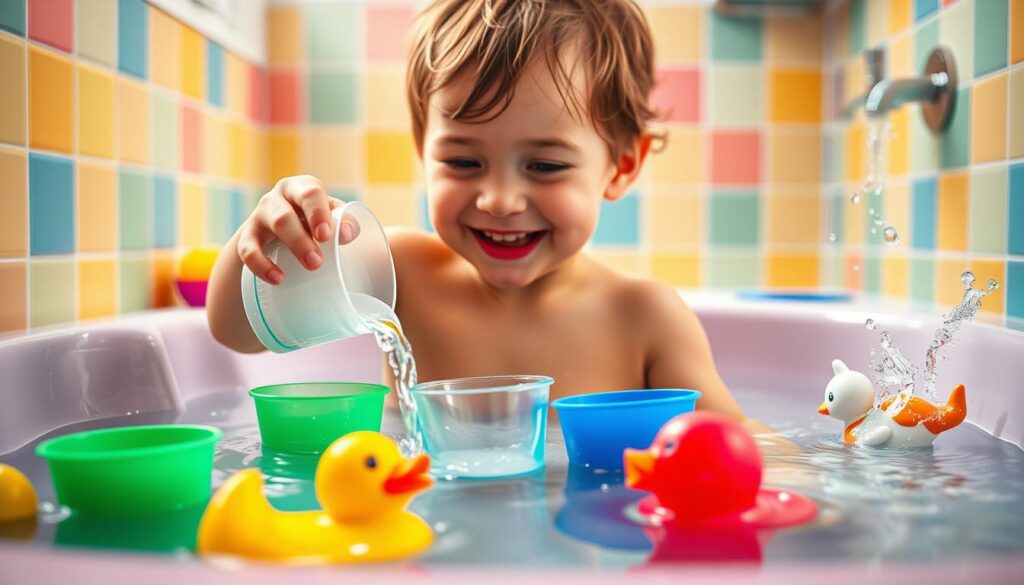
Teaching “under” is easy with a blanket on the floor. Bath toys and cups work the same way. You already have everything you need.
Start with one preposition at a time. Use simple phrases like “Put the duck IN the bucket”. Then try “Put the boat ON the water.” Keep it simple and repeat.
Here are some fun games for different prepositions:
- In & On: Use nested cups or a floating basket. Ask your child to put a toy “in” the big cup or “on” the rim.
- Under: Hide a small toy “under” a plastic cup or “under” the washcloth. Let them find it and describe where it was.
- Behind: Place a rubber duck “behind” the shampoo bottle. Ask, “Where is the duck hiding?”
- Through: Use a cup with holes, a sieve, or a funnel. Demonstrate pouring water “through” it. This introduces a fun, dynamic concept.
Once your child gets one word, mix two together. Start with simple combinations. Say, “Put the red duck UNDER the big cup” or “Take the blue boat from BEHIND the soap and put it IN the bucket.” This improves listening and follows a logical sequencing routine.
Bath time becomes a language lab with toys. Moving toys makes words like “through” or “behind” clear. It also makes bath time more fun and predictable, helping your child know what’s next.
Follow your child’s lead and keep it fun. Even if they just play with water, it’s good practice. The goal is to make learning fun and natural.
Visual choice boards for requests and transitions
Make bath time a conversation with simple pictures. Pictures help your child express their needs when words fail. This way, you follow their lead in a clear, practical way.
Visual aids can turn frustration into clear communication. They show your child their options and what’s next. This makes bath time more predictable and calm.
Creating a waterproof choice board is simple. Use laminated pictures or symbols on the shower wall. Include bath toys and action words like “pour” and “splash.”
When your child picks a picture, act on it. This builds understanding and confidence. For example, if they choose “pour,” give them a cup.
These boards help with making requests. Your child can ask for more bubbles or a different toy without getting upset. It boosts their confidence and independence.
For moving from one activity to another, a visual schedule is key. A simple chart shows the steps: “Play,” “Wash,” “Rinse,” “Dry.” It helps children see the structure of bath time.
This visual guide makes leaving the tub easier. Show the “dry” picture a few minutes before. It helps your child mentally prepare, reducing tantrums.
| Type of Visual Aid | Primary Purpose | Example in Bath Time |
|---|---|---|
| Choice Board | Allows child to select an item or activity | Pictures of cup, boat, soap, sponge for toy selection |
| Visual Schedule | Shows the order of activities (sequencing routine) | Photos in order: undress, bath, dry, pajamas |
| First-Then Board | Clarifies a required task before a preferred one | “First wash hair, then play with boats” |
| Request Card | Helps child ask for a specific need | A single “more bubbles” picture to hand to parent |
Begin with simple pictures. Use two or three at first. Place the board where your child can see and reach it. Keep the language positive and the routine consistent.
These visual tools support language growth in a stress-free way. They give your child control in a safe bath setting. This turns daily bath time play into a lesson in communication and cooperation.
Simple science play: color tabs and foam letters
Bath time turns into a discovery zone with color-mixing tablets and foam letters. This bath time play makes the tub a hands-on lab for kids. It taps into their curiosity about water and movement.
Dissolvable color tablets are amazing. Drop one in, and watch your child’s face light up. You can teach color names like “red,” “blue,” and “yellow.” Then, mix them. Say, “Look! The blue water and the yellow tablet are making green!” This simple mix teaches cause and effect and builds vocabulary.
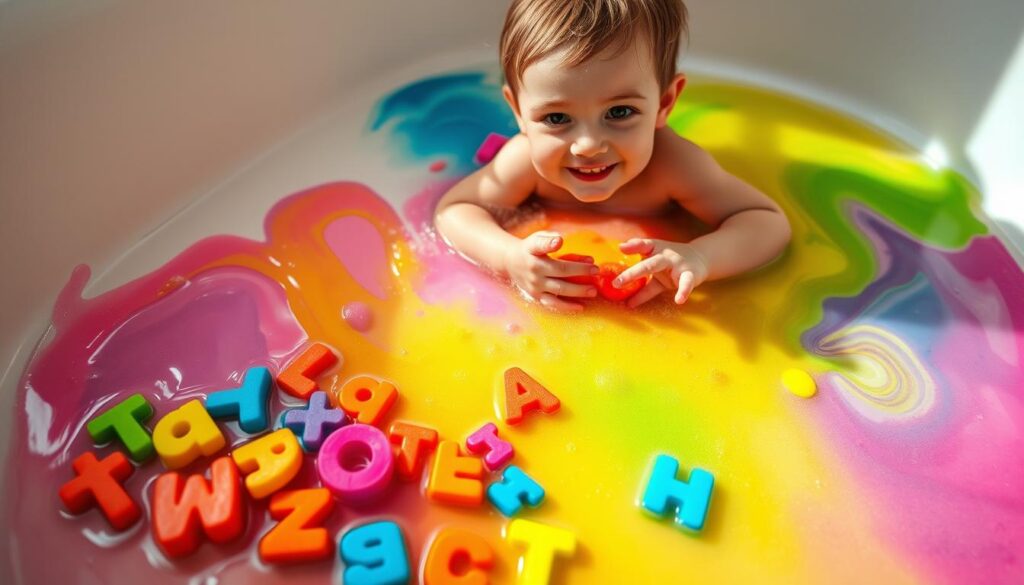
Foam letters are great for bath-based learning. They help explore floating and sinking. Ask, “Does the letter ‘A’ float or sink?” or “Can you make the ‘B’ dive under the water?” This play makes learning fun.
Use these letters for language too. Stick them to the wet wall to practice:
- Letter names and sounds
- Spelling a child’s name
- Creating simple words like “CAT” or “DOG”
Follow your child’s lead. Are they more into colors or letters? Narrate what you see. Say, “You’re pouring water over the letters. Now they’re sliding down the wall!” This connects actions to words, making play a language lesson.
The goal isn’t a perfect experiment. It’s about shared curiosity and conversation. This approach to bath time play makes learning about colors, letters, and floating/sinking fun. For more ideas, check out our resource on encouraging speech sounds.
Safety reminders and calm exit cues
Adding simple safety tips to a calm exit plan makes bath time better. This part of the bath is where your sequencing routine really helps. It boosts both language skills and emotional control.
Make safety talk fun. Instead of saying “Don’t stand!”, say, “Sit down, please, so you can play with the cups.” This makes following the rule fun. Use prepositions in water too: “Keep your bottom on the tub floor” or “Let’s put the boat behind you.”
Use gentle warnings for smooth transitions. Say, “Five more minutes of pouring, then all done.” Then repeat it a minute later. This builds excitement and helps your child understand the change.
When it’s time to leave, use clear words and signs. This shows what’s next and helps your child accept it.
- Verbal Cue: “All done bath. Time to drain the water.”
- Action + Preposition: “Let’s put the duck in the basket.”
- Visual Cue: Hold up the towel and say, “Towel time!”
This routine—warning, cleanup, exit—makes your child feel safe. They learn to connect words with actions. They understand “all done” and “next.” Turning off the water becomes a signal, not a shock.
Ending on a positive note strengthens your bond. It makes bath time more successful. A calm exit shows that routines are safe and easy to follow.
Dry‑off retell and pajama checklist routine
The learning doesn’t stop when the bath is over. The cozy moments after are great for more language practice. Use drying off to tell stories and recap bath time fun.
While drying, tell simple stories of what happened. Say, “First we got wet. Then we made the boat go under the bridge!” This helps your child remember. It also teaches sequencing words and past tense verbs in a fun way.
Then, show a visual pajama checklist. Make a simple chart with pictures for each item. Point to each as you dress your child. Say, “Shirt goes on your arms. Pants go on your legs.” This makes dressing predictable.
This checklist helps your child learn about body parts and clothes. It gives a clear guide for what comes next. It makes dressing time calm and connected.
These steps add language to your evening routine. Consistent, loving interaction during dressing solidifies bath time learning. You make bedtime smooth and learning-filled.