

For families watching early communication, CDC language screening guidance gives clear ages to ask whether a child’s development is on track and whether a closer evaluation may be needed. The main message is practical: screening is not about labeling a child after one missed skill. It is a structured way to notice patterns early, especially in speech, language, social communication, movement, learning, and behavior.
The CDC describes developmental monitoring as ongoing observation of how a child grows and changes, while developmental screening uses a validated tool to look more closely at development. The American Academy of Pediatrics recommends developmental screening for all children at 9, 18, and 30 months, and autism-specific screening at 18 and 24 months, according to the CDC’s page on developmental monitoring and screening. The same CDC guidance says screening should also happen whenever a parent, caregiver, or healthcare provider has a concern, even outside those routine ages.
What CDC Language Screening Checks And When
CDC Language Screening At 9, 18, And 30 Months
The routine developmental screening ages of 9, 18, and 30 months are broad developmental checkpoints. They are not limited to speech, but language concerns often appear during these visits because communication changes quickly across the first three years of life. A child may be gaining gestures, first words, word combinations, or early grammar during a short period of time, so missed opportunities for screening can delay helpful conversations.
At 18 and 24 months, autism-specific screening is also recommended. That does not mean every child with a language delay has autism, and it does not mean screening gives a diagnosis by itself. Screening identifies whether more evaluation is needed. For a family, this distinction matters because it keeps the next step focused: share concerns, complete the tool, and ask what follow-up is appropriate.
Screening Is Different From Daily Monitoring
Daily monitoring happens in ordinary routines. A parent may notice whether a baby turns toward voices, whether a toddler waves, whether a child tries new words, or whether frustration increases because communication is hard. Screening is more formal. It uses a tool designed to compare a child’s development with expected age markers.
Both parts are useful, but neither should be treated as perfect. A child may behave differently at an appointment than at home. A bilingual child may use one language with one caregiver and a different language with another. A child may understand more than they can say. These details should be shared with the provider so the screening conversation reflects the child’s real communication across settings. Families looking specifically at bilingual development may also find related age-marker discussion in bilingual speech milestones.
This page is part of a wider information network; you can explore more about related topics on another site, Alliance Recruitment. Developmental decisions, however, should be discussed with pediatric, early-childhood, or speech-language professionals who can review the child’s needs directly.
Language Milestones To Watch By Age
By 12 And 18 Months
The CDC milestone system uses age-based skills that most children are expected to show by a given age. In the 2022 milestone revision, milestones were selected so that at least 75% of children would be expected to achieve them by the listed age, as described in the CDC-supported paper on evidence-informed milestones. This matters because the checklists are not meant to describe the earliest possible age for a skill. They are meant to help families and professionals notice when a child may need closer attention.
By 12 months, the CDC language and communication milestones in the research provided include waving “bye-bye,” calling a parent “mama,” “dada,” or another special name, and understanding “no” by pausing or stopping. If a 12-month-old is not using familiar names, not gesturing, or not responding to “no,” that does not prove a long-term language disorder. It does mean the concern is worth discussing rather than waiting quietly.
By 18 months, most children try to say three or more words besides “mama” or “dada.” For some children, words may be approximations rather than perfectly clear adult speech. The key question is whether the child is using intentional spoken words or word-like forms to communicate. If a child has fewer than three words beyond parent names by this age, additional screening or evaluation may be appropriate.
By 24 And 30 Months
By about 24 months, the research notes identify two-word combinations, such as “more milk,” as an expected communication marker for most children. Word combinations show that a child is beginning to join ideas, not only label single objects. If a child is not combining two words around this age, families can ask whether hearing, language understanding, expressive language, and social communication should be reviewed.
By 30 months, the CDC milestones in the research provided include having about 50 words, saying two or more words together with an action word such as “doggie run,” naming things in a book when asked, and using pronouns such as “I,” “me,” or “we.” Pronouns can develop unevenly, and bilingual children may show different patterns across languages. Still, the presence or absence of these skills gives families concrete information to bring to a healthcare visit.
| Age | Language Or Communication Marker | Reason To Ask For Follow-Up |
|---|---|---|
| 12 months | Waves, uses a parent name, responds to “no” | No gestures, no familiar names, or limited response to simple language |
| 18 months | Tries at least three words besides “mama” or “dada” | Fewer than three words beyond parent names |
| 24 months | Uses two-word combinations | Not joining two words to communicate |
| 30 months | About 50 words, action-word phrases, book naming, early pronouns | Very limited vocabulary, no action-word phrases, or limited naming when asked |
How Families Can Respond To Concerns
What To Share With A Provider
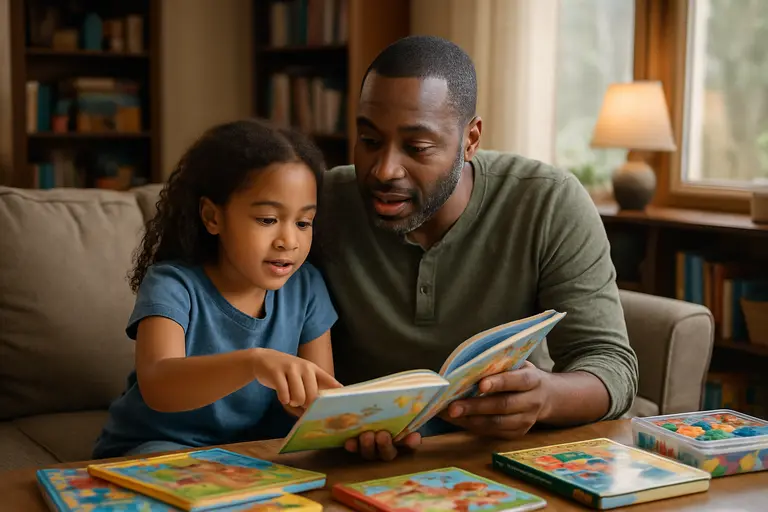
CDC language screening works best when caregivers bring specific observations. Rather than saying only, “I am worried about speech,” it can help to describe what the child does during meals, play, books, dressing, and familiar routines. If the child uses words in one language but not another, say that. If the child points, pulls an adult’s hand, imitates sounds, follows simple directions, or becomes upset when not understood, those details are relevant.
Families can prepare for a visit by noting examples from the past week. The notes do not need to be long. A few real examples often help more than a general impression. For instance, a caregiver might write, “She says ‘mama’ and ‘up,’ but no other words,” or “He points to the refrigerator and cries but does not use a word or sign.” These observations can support a clearer screening discussion.
Supportive Communication At Home
While waiting for a screening appointment or referral, families can keep communication warm and responsive. The goal is not to pressure a child into performing. A caregiver can comment on what the child is doing, pause so the child has time to respond, repeat the child’s sounds or words, and add one small piece of language. If a child says “ball,” the adult might say, “big ball” or “roll ball.”
- Use short phrases during routines, such as “wash hands,” “more banana,” or “shoes on.”
- Offer choices with words and gestures, such as “milk or water?” while showing both.
- Read simple books and name pictures the child notices.
- Respond to gestures, sounds, and words as meaningful communication when possible.
- Share concerns promptly instead of waiting for the next scheduled visit if development seems to be slowing or stalling.
These steps are not a substitute for screening or evaluation. They are everyday ways to keep interaction available while the family seeks professional guidance. If a child has possible hearing concerns, regression, feeding concerns, limited response to people, or loss of words, families should raise those concerns directly with a healthcare provider.
CDC Language Screening For Language Delays
A Careful Way To Use Milestones
CDC language screening should be understood as an early-warning process, not a single verdict. The 2022 CDC milestone update changed the checklist structure: the research notes report about 26% fewer total milestones, about 41% of milestones replaced, and about one-third of retained milestones moved to different ages, with 67.7% of moved milestones shifted to older ages. Those changes are a reminder that milestone tools are revised as evidence and clinical needs are reviewed.
For parents and educators, the practical use is still clear. The key screening ages are 9, 18, and 30 months for general development, with autism-specific screening at 18 and 24 months. Language concerns can also justify screening at any age. If a 12-month-old is not gesturing or using familiar names, if an 18-month-old has very few words, if a 24-month-old is not combining words, or if a 30-month-old has very limited vocabulary or phrase use, asking for further review is reasonable.
CDC language screening gives families a shared framework for talking with pediatric providers, early educators, and specialists. It does not replace professional evaluation, and it cannot explain every child’s language profile on its own. Used carefully, though, it helps adults notice concerns earlier, document what they see, and take the next step with less guesswork.