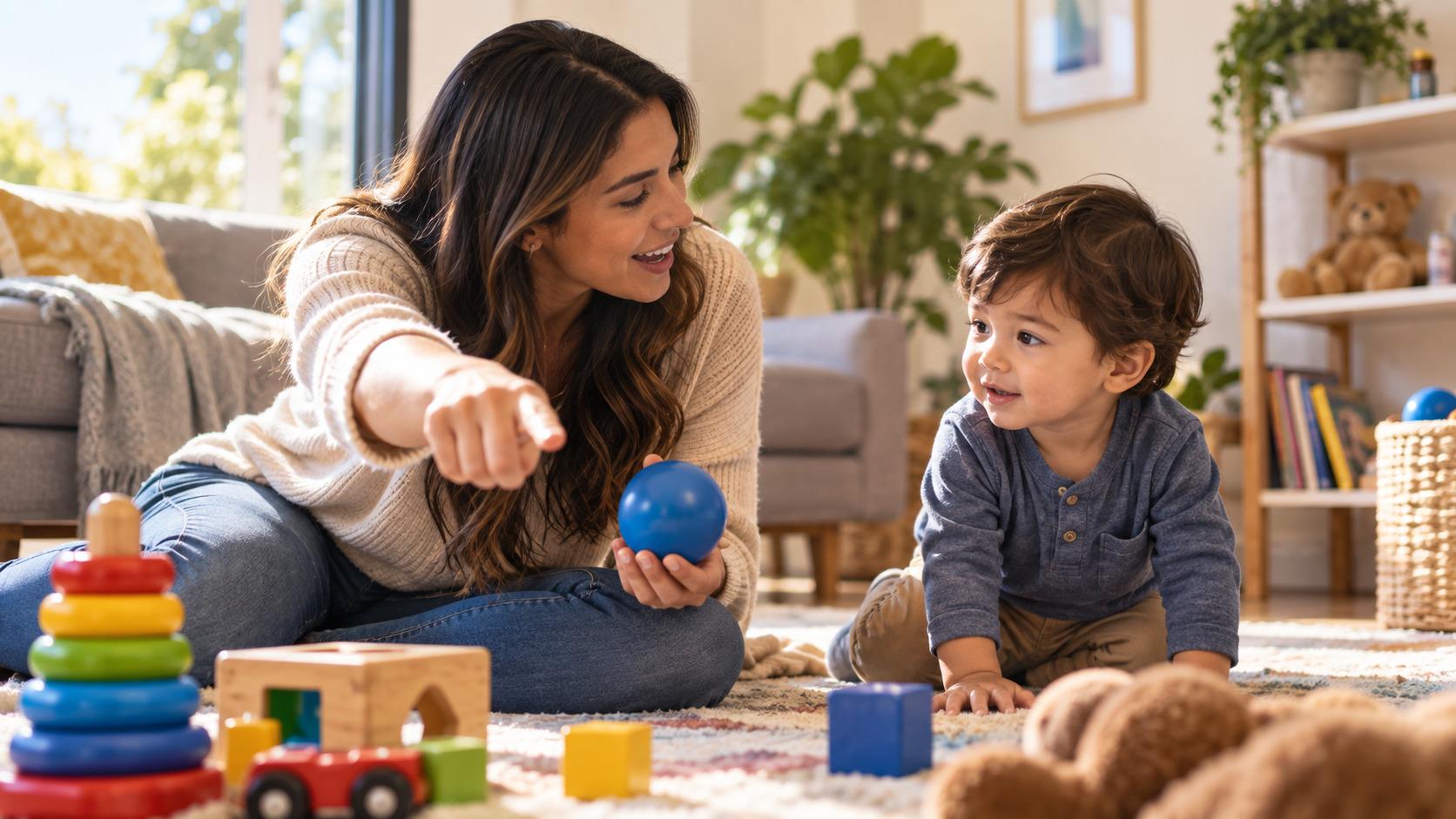
A parent says, “Put this piece over there,” while pointing to the correct spot. Another says the same sentence without moving. The words match, but the child is not receiving the same information. New research is adding another layer to what we know about gestures and language development: meaningful movements may help adults and children coordinate attention while making spoken information easier to interpret.
The practical lesson is not that parents need to invent a sign for every sentence. It is that ordinary actions—pointing, showing direction, demonstrating size, or moving an object while naming the action—can give children another route into meaning. That idea extends beyond gestures during story time and into puzzles, cleanup, getting dressed, cooking, building, and other moments when a child has to understand what someone means.
Gestures and language development work as one message
Adults often treat speech as the message and gestures as decoration. For young children, the two can work together.
Imagine telling a toddler, “Your shoes are under the chair,” while pointing beneath the chair. The word “under” describes a spatial relationship, but the hand movement makes that relationship visible.
Likewise, an adult might say “Make it taller” while moving a hand upward, “Turn it around” while rotating a hand, or “Put this one beside that one” while showing the two positions.
These movements do not replace language. They clarify the language at the moment the child is trying to connect words with objects, actions, or relationships.
Developmental milestones already reflect this partnership. By 15 months, many children can follow a direction when an adult combines words with a gesture, such as holding out a hand while asking for a toy. Current 15-month communication milestones also include pointing to request something or seek help.
A new study looked inside the interaction
A University of Iowa study released in September 2026 gives the idea a particularly interesting twist.
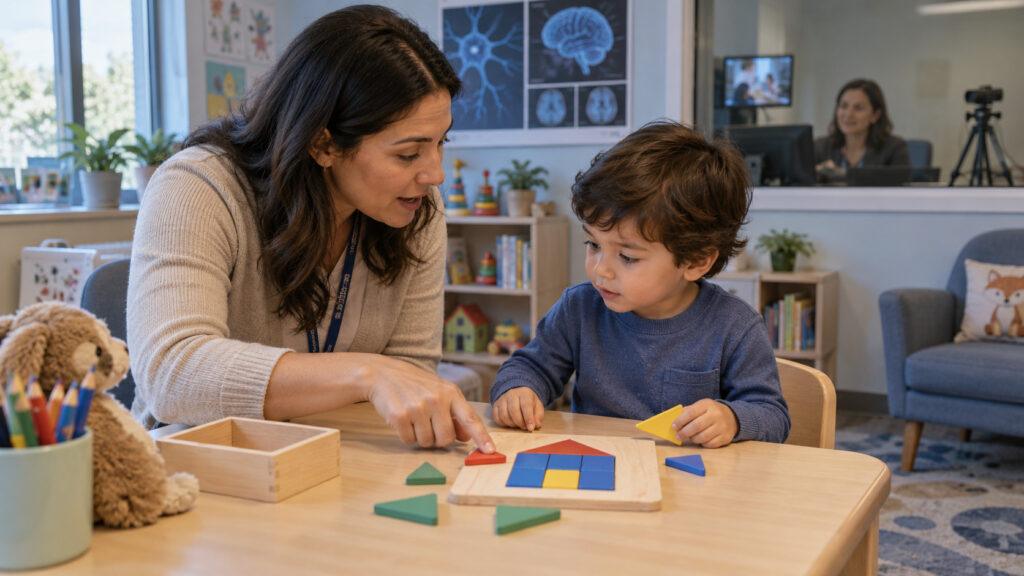
Researchers observed 42 parent-child pairs while they worked on seven-piece puzzles. Parents and children were monitored simultaneously as they tried to create shapes such as a house or bird.
The researchers compared interactions in which adults used different levels of guidance. When parents combined speech with gestures, parent and child brain activity showed stronger sustained synchrony during the task than when guidance relied on speech alone or little guidance was provided.
The parent-child synchrony findings should not be interpreted as proof that gesturing automatically improves every child’s language. The task involved puzzle solving, not a long-term language intervention.
What it does offer is a useful picture of shared attention in action. Gesture may help package information so the adult and child are focused on the same relationship at the same moment.
Some ideas are easier to show than explain
Gesture becomes especially useful when language describes space, movement, quantity, direction, or physical relationships.
A long verbal explanation can sometimes add unnecessary language. A short phrase plus a meaningful gesture may communicate the same idea more clearly.
| Everyday situation | Words an adult might use | Helpful gesture |
|---|---|---|
| Building blocks | “Put it on top.” | Point above the tower |
| Cleanup | “Those go inside.” | Point into the basket |
| Dressing | “Pull it up.” | Move hands upward |
| Cooking | “Stir slowly.” | Make a slow circular motion |
| Outdoor play | “Go around the puddle.” | Trace a curved path |
| Puzzle play | “Turn this piece.” | Rotate a hand |
The strongest gestures provide information that matches the words. Random movement may attract attention, but it does not necessarily make the message easier to understand.
This is why meaning matters more than movement.
Follow the child’s attention instead of performing
Once parents hear that gesture can support learning, it is easy to overdo it.
A conversation does not need choreography. If an adult points, waves, demonstrates, and acts out every sentence, the extra movement may become distracting rather than useful.
Start with moments when the child is already interested in something. If a toddler points toward a dog, the adult might point too and say, “That dog is running.” If a preschooler struggles to position a puzzle piece, the adult can say, “Turn it this way,” while rotating a hand.
The child’s gestures deserve attention too.
Pointing at a snack, handing an adult a closed container, showing a toy, nodding, shaking the head, or reaching toward an object can all carry communicative information. Responding to that message with relevant words helps connect the child’s intention with language.
A gesture does not have to be replaced immediately by speech to be valuable.
Everyday routines offer better practice than gesture drills
Families do not need flashcards or scheduled gesture practice.
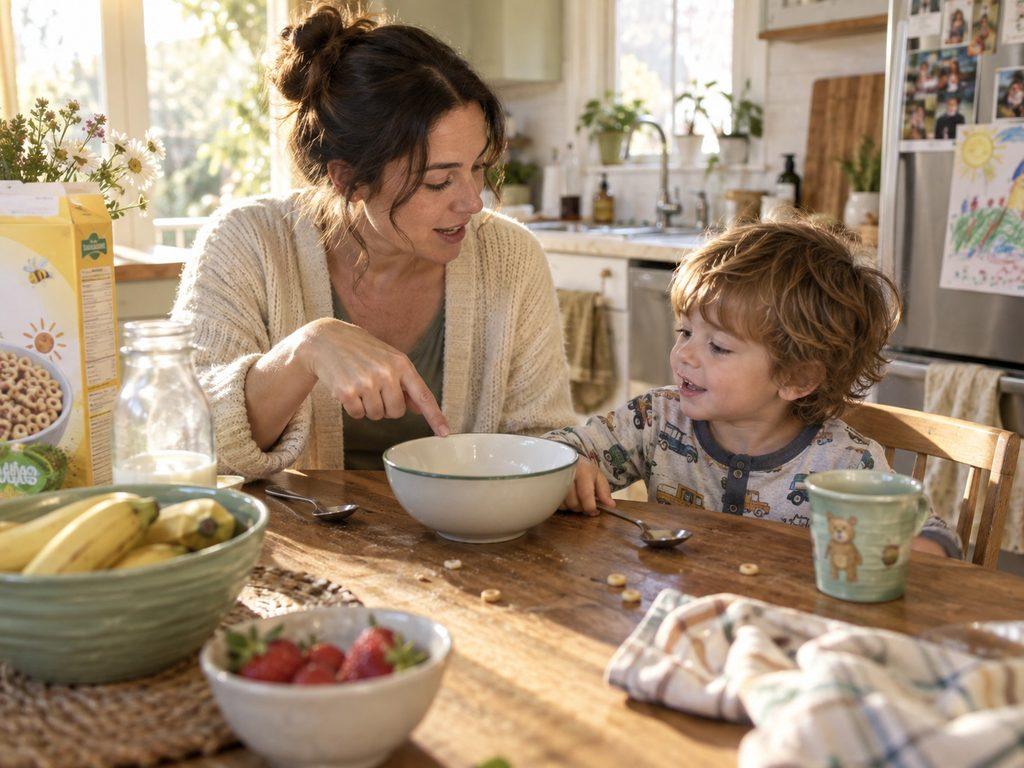
During breakfast, point to the empty bowl while saying, “Your cereal is all gone.” During bath time, demonstrate “pour,” “squeeze,” or “wash.” When packing a bag, show “inside,” “next to,” and “under” as those relationships actually occur.
This approach has two advantages. The meaning is visible, and the child already has a reason to pay attention.
Parents can also pause after pairing words and gestures. A child may respond by looking, moving, pointing, making a sound, using a word, or attempting the action.
That response creates a conversation rather than a lesson.
The aim should be clearer shared communication, not getting a child to imitate every gesture or repeat every phrase on demand.
The next question is not simply whether gestures “work”
The newer research makes gesture more interesting, but it also calls for restraint.
A small laboratory study showing parent-child neural synchrony during puzzle solving cannot tell families exactly how much gesturing to use, which children benefit most, or whether a particular technique will accelerate spoken-language milestones.
Those questions require broader research across ages, communication profiles, tasks, and longer periods of development.
For families, the practical signal is simpler. Notice whether gestures make an instruction, new concept, or shared activity easier for the child to follow. Use them when they add information. Reduce them when the child understands without them.
Gestures and language development are not competing systems in which hands must disappear once speech grows. Communication has always been multimodal. Children watch faces, movements, objects, and actions while listening to words. The opportunity for adults is to make those channels reinforce one another—using a well-timed point, demonstration, or movement to make the meaning behind a sentence easier to see.
Frequently asked questions
Can gestures delay a child from learning to talk?
Using gestures does not mean adults should stop providing spoken language. Pairing meaningful gestures with words gives children both visual and verbal information and can support communication while spoken language continues developing.
What gestures are most useful for young children?
Simple gestures connected directly to meaning work well: pointing toward an object, demonstrating an action, showing direction with a hand, nodding yes, shaking the head no, or showing size and position.
Should parents ask children to copy every gesture?
No. Children can benefit from watching meaningful gestures without being required to imitate them. Follow the child’s attention and treat spontaneous pointing, showing, reaching, and other communication attempts as opportunities for natural interaction.