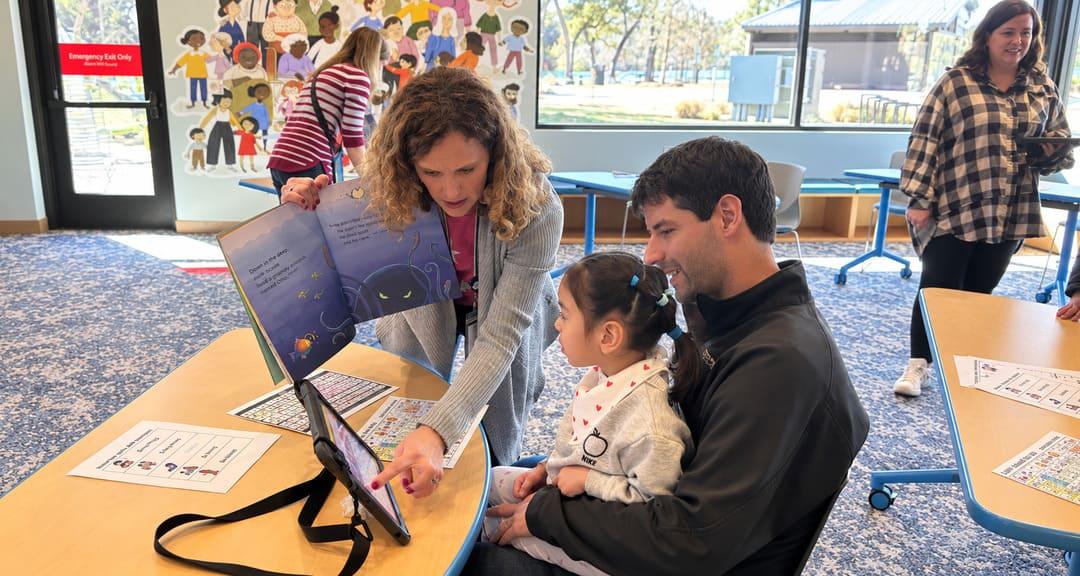
Reading together should give children a chance to share ideas, make choices, and enjoy a story—even when spoken words are difficult or unreliable.
For children who use augmentative and alternative communication (AAC), storytime can include pointing to pictures, selecting messages on a communication device, using signs, making sounds, or responding through facial expressions and body movements.
The goal is not to make a child produce the correct word on every page. It is to make reading a shared experience in which the child’s communication matters.
Parents and educators can support this by keeping communication tools accessible, modeling useful messages, allowing time for responses, and following the child’s interests.
What AAC Adds to Shared Reading
AAC includes methods that help people communicate when speech alone does not meet their needs.
Some children use picture boards or communication books. Others use speech-generating devices, signs, gestures, or several methods together.
The American Speech-Language-Hearing Association’s AAC guidance explains that communication systems should reflect each person’s abilities, needs, languages, and everyday situations.
During storytime, AAC gives children additional ways to participate.
A child looking at a picture of a puppy might:
- Point toward the animal.
- Select a message meaning “dog” or “look.”
- Make a sound or smile.
- Use a device to say “funny.”
- Signal that they want another page.
- Indicate that they would rather read something else.
Each response can contribute to a meaningful interaction.
A communication device is not simply a tool for answering questions. It can also help children express opinions, share excitement, ask questions, and direct an activity.
This matters because reading should involve the child’s thoughts, not just the adult’s instructions.
What Research Shows About AAC and Book Reading
Research suggests that shared reading can provide useful opportunities for children who communicate through AAC, although studies involving very young AAC users remain limited.
A 2024 study by Braelyn Wence, Ciera Lorio, and Amy Yacucci examined shared book reading in five families with children aged 35–48 months who used AAC.
According to the study information available through ASHA’s research repository, children communicated in multiple ways, and caregivers used different strategies to support participation.
For two families observed both with and without AAC during shared reading, sessions lasted longer when AAC was included.
That finding deserves careful interpretation.
Longer reading sessions do not automatically mean better language development. The study was small and descriptive, so it cannot establish that a particular activity causes language improvements.
An earlier study provides another useful piece of evidence.
Researchers Jennifer Kent-Walsh, Cathy Binger, and Zishan Hasham investigated a program that taught six parents communication-partner strategies during storybook reading.
In the 2010 parent-instruction study, all six parents learned to use the strategies, and their children increased communicative turn-taking and expressed a wider range of meanings during the observed activities.
The results suggest that teaching adults how to support interactions may be valuable.
However, six participating families cannot represent every child who uses AAC. The findings also do not establish that one reading technique will work for everyone.
The practical lesson is to support meaningful participation rather than measure success only by spoken words or correctly identified pictures.
A Simple AAC Storytime Routine
Families do not need a special set of expensive books to make shared reading more accessible.
A familiar picture book, the child’s existing communication tools, and a comfortable reading position can provide a starting point.
The following routine is a suggested way to apply responsive communication principles. It is not a standardized intervention or a guarantee of developmental progress.
1. Let the Child Help Choose the Book
Begin by offering a genuine choice between two familiar books.
Hold them where the child can see or otherwise access them. Allow the child to communicate a preference through their usual method.
That could be a look, a gesture, a spoken word, a picture selection, or a device-generated message.
If their preference is unclear, check gently rather than assuming.
For example:
“You looked at the animal book. Is that the one you want?”
Choosing a book gives communication an immediate purpose.
If a child is not interested in either option, that information matters too. Try a different book or activity rather than insisting on a particular selection.
2. Keep AAC Available Throughout the Story
Before opening the book, make sure the child’s communication system is accessible.
A device should be positioned so the child can reach or otherwise use it. A communication board should remain visible and available.
Children who use alternative access methods, such as eye gaze or switches, may need specific positioning and support.
Avoid changing device settings, symbol layouts, or access methods without guidance from the professionals and family members who know the child’s system.
The book and communication tool should work together.
An adult who must repeatedly leave the reading area to retrieve a device may unintentionally interrupt the conversation.
For more guidance on keeping communication accessible across daily routines, see our article on helping children communicate their needs without pressure.
3. Model a Few Useful Messages
AAC modeling means showing a child how someone can use their communication system during a real interaction.
For example, when a puppy falls into a puddle, an adult might say:
“Oh no! The puppy fell!”
While speaking, the adult could select or point to an available message meaning “oh no,” “look,” or “funny.”
The exact message depends on the child’s established communication system.
There is no need to select every word in the sentence.
A few meaningful examples may be easier to follow than constant device use.
Modeling should not automatically become a request for imitation.
The child does not need to repeat the message, activate the same symbol, or demonstrate understanding before the adult continues reading.
4. Make Comments Before Asking Questions
Adults often ask children to identify objects during book reading.
“What is this?”
“What color is that?”
“Where is the dog?”
These questions can be useful in the right context, but asking them repeatedly can turn an enjoyable story into a test.
Try making a comment instead.
“The dog is hiding.”
“That looks really messy!”
“I think the puppy wants to go outside.”
Then pause to see whether the child wants to respond.
A child might laugh, look toward the picture, point, make a sound, or use AAC to add a message.
When the child responds, acknowledge their contribution and continue the exchange.
For example:
Child: Selects “more.”
Adult: “You want more of the story. Let’s see what happens.”
Comments can create openings for participation without requiring one predetermined correct answer.
Give Every Communication Method Room
Children do not always communicate in the same way throughout an activity.
Someone who usually uses a speech-generating device may occasionally point, gesture, vocalize, or communicate through facial expressions.
These methods can work together.
Parents and teachers should pay attention to the message rather than insisting on one particular form of expression.
If a child’s meaning is uncertain, acknowledge the attempt and check what they intended.
A smile might show enjoyment, but it does not always mean yes. Looking away might indicate a desire to stop, difficulty seeing, fatigue, or interest in something else.
Careful observation and confirmation help adults avoid assigning meanings the child did not intend.
Allow Enough Response Time
Some children need additional time to understand a question, locate a message, plan a movement, or operate their AAC system.
After making a comment or inviting participation, pause without immediately filling the silence.
There is no universal number of seconds that works for every child.
Watch for signs that the child is preparing a response and adjust the pace accordingly.
If no response comes, the adult can model a possible message and continue naturally.
The child should not have to perform on demand for storytime to remain enjoyable.
Make Room for Opinions and Refusals
Communication is more than naming objects and requesting another page.
Children should also have opportunities to express preferences.
Useful messages might include:
- “I like it.”
- “That’s funny.”
- “Again.”
- “Different book.”
- “Stop.”
- “All done.”
These examples are possibilities, not a required vocabulary list.
The words and symbols available to each child should reflect their individual communication system.
If a child clearly indicates that they want to stop, respect that message whenever possible.
Responding to refusal helps demonstrate that communication can influence what happens.
Choose Books That Encourage Participation
The best book is not necessarily the one with the most vocabulary or the greatest number of educational activities.
Look for books that match the child’s interests, developmental needs, and preferred ways of accessing information.
For some toddlers and preschoolers, useful features include:
Clear illustrations: Pictures with recognizable actions may provide natural topics for comments and questions.
Repeated events: Familiar patterns can create opportunities to anticipate what happens next or request another turn.
Interesting characters: Animals, vehicles, everyday routines, or favorite fictional characters may encourage engagement.
Choices and surprises: Unexpected events can invite opinions, reactions, and predictions.
Accessible formats: Some children benefit from larger images, adapted page-turning, stable book positioning, tactile materials, or alternative ways of accessing a story.
These are practical selection considerations, not a claim that one book format is scientifically proven to be best for every AAC user.
Revisiting a favorite book can also be valuable.
A familiar story may make it easier for a child to focus on communicating rather than processing an entirely new sequence of events.
For families looking for additional ways to create meaningful interactions, our guide to play-based language learning explains how following a child’s interests can support everyday communication.
AAC Should Not Be Treated as a Barrier to Speech
Some caregivers worry that providing pictures or a speech-generating device will discourage a child from developing spoken language.
That concern should not prevent families from seeking appropriate communication support.
The American Academy of Pediatrics explains in its guidance on AAC for children that AAC does not prevent or reduce verbal speech development.
AAC can be introduced early, and children do not need to master one type of communication tool before another can be considered.
Children’s communication needs and outcomes still vary widely.
Some children use AAC alongside growing spoken language. Others continue using AAC as a primary communication method.
Neither situation should be treated as a failure.
During reading, the aim is to provide access to language, interaction, and participation while respecting the child’s existing communication abilities.
When Families May Need Additional Support
Parents and educators may benefit from professional guidance when a child cannot reliably access their communication system, struggles to express important messages, or regularly becomes distressed during communication activities.
A speech-language pathologist experienced in AAC can help assess communication needs and support families in using appropriate tools.
Depending on the child, collaboration with occupational therapists, physical therapists, vision professionals, hearing specialists, or educators may also be helpful.
Families should also seek professional advice if a child loses previously acquired communication skills or has persistent difficulties understanding or expressing language.
The child’s age, hearing, physical access, languages, developmental history, and everyday communication environment may all be relevant.
Caregivers do not need to wait for a child to develop reliable speech before discussing AAC support with a qualified professional.
A Better Way to Recognize Storytime Success
A successful reading session does not have to end with a new spoken word.
It might involve a child choosing the book, sharing a joke through AAC, asking for another page, showing interest in a character, or communicating that they are finished.
Adults can notice which books encourage participation, which messages are useful, and whether the child can comfortably access their communication tools.
These observations can help families and professionals adapt future activities without treating every session as a formal assessment.
Most importantly, storytime should remain a shared experience.
When children can communicate through methods that work for them, books become more than objects to identify or sentences to repeat. They become opportunities to express ideas, connect with others, and participate in a conversation.