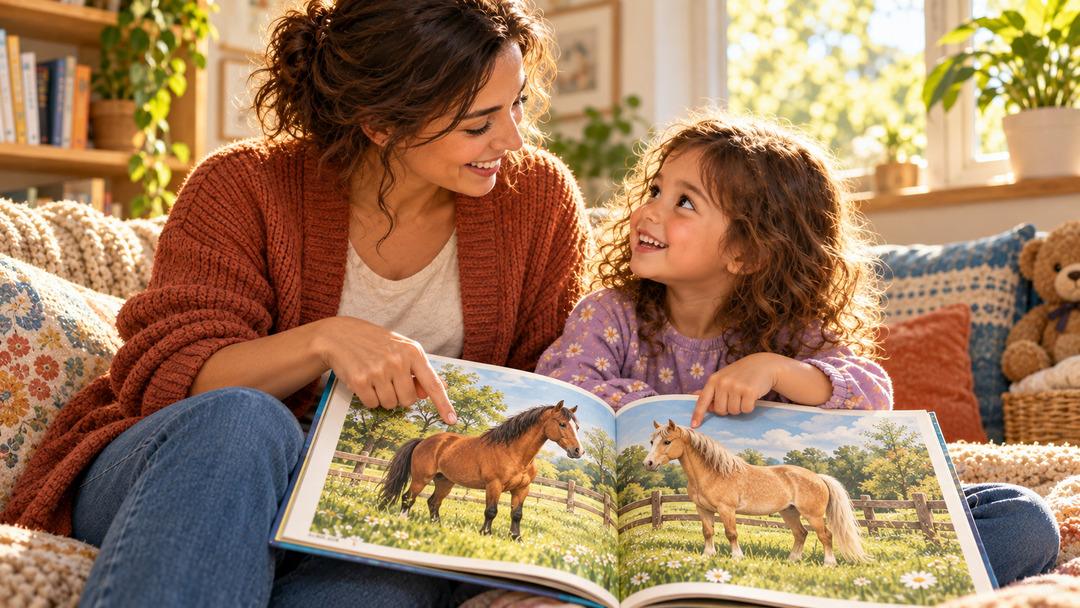

When an adult says “hold your horses,” a preschooler might wonder where the horses are. Tell a young child that something is “a piece of cake,” and they may start looking for dessert.
These misunderstandings can be a normal part of language development. Young children are still learning that words sometimes communicate meanings beyond their literal definitions.
But preschoolers are not simply incapable of understanding figurative language. Research shows that some children can recognize simple comparisons and metaphors surprisingly early, while unfamiliar idioms and sarcasm may remain difficult for years.
The most helpful approach is to explain unfamiliar expressions in everyday language, connect them to the situation, and give children opportunities to ask what someone means.
Parents and educators do not need to teach long lists of idioms. A familiar expression, a brief explanation, and a playful conversation can introduce the idea that words sometimes have more than one meaning.
Why “Hold Your Horses” Is Confusing to a Young Child
Children learn language by connecting words with people, objects, actions, and experiences.
When a toddler hears “horse,” they may think about an animal they have seen in a book, on a farm, or in a video.
That interpretation makes sense.
However, the phrase “hold your horses” usually means to wait or be patient.
Understanding it requires the listener to recognize that the speaker is using a familiar combination of words with a special meaning.
This type of expression is called an idiom.
Other common English idioms include:
- “It’s raining cats and dogs,” meaning it is raining heavily.
- “A piece of cake,” meaning something is easy.
- “Spill the beans,” meaning reveal a secret.
- “Under the weather,” meaning feeling unwell.
The individual words do not always provide enough information to explain the intended message.
A child who interprets one of these expressions literally is responding to the words they recognize.
They may simply have limited experience with the expression’s other meaning.
Adults can make the message clearer without suggesting that the child’s interpretation is foolish.
For example:
Adult: “Hold your horses. We need to put on our shoes first.”
Child: “What horses?”
Adult: “There aren’t any horses. That’s a funny saying that means wait a moment. I mean we need our shoes before going outside.”
The explanation answers the immediate question and introduces the expression naturally.
What Research Reveals About Figurative Language Development
Not all figurative expressions are equally difficult.
A metaphor, an idiom, and a sarcastic comment may all have nonliteral meanings, but understanding them can involve different language and thinking skills.
Recent research challenges the idea that young children always interpret language literally.
A 2025 study on metaphor comprehension in preschool children examined how children understood comparisons involving objects and more abstract relationships.
Researchers Ariel Starr, Taylor Petersen, and Sahana Sridhar conducted two preregistered studies involving 276 children with an average age of approximately 3.7 years.
The children demonstrated an ability to understand both kinds of metaphors within the study’s structured tasks.
The researchers also found comparable performance among participating monolingual and bilingual children.
This is an important qualification to the common belief that preschoolers cannot understand figurative meaning.
However, understanding a metaphor during a structured research activity does not mean a child will recognize every unfamiliar expression during conversation.
Metaphors and idioms are not identical.
A metaphor often invites a comparison between two things.
For example, someone might say that a child is “a little sunshine” to communicate that the child brings happiness.
An idiom such as “spill the beans” has a conventional meaning that may be difficult to work out from the individual words.
Familiar Expressions Can Be Easier to Understand
A 1991 study published in the Journal of Speech, Language, and Hearing Research investigated how children interpreted different kinds of idioms.
Researchers presented expressions to children in kindergarten and several elementary school grades.
Younger children generally understood idioms better when the meanings of the individual words provided clues to the overall figurative meaning.
For example, “lend a hand” has a recognizable connection to helping someone.
By comparison, “spill the beans” offers less obvious information about revealing a secret.
The study also examined whether short stories helped children interpret expressions.
The findings suggest that the relationship between an idiom’s literal and intended meanings can affect comprehension.
This does not establish a particular birthday when children should understand idioms.
Instead, it shows why some expressions may be easier to learn than others.
Children’s Experiences Shape Which Sayings They Recognize
Adults sometimes forget how much background knowledge an everyday expression requires.
Consider the phrase “break the ice.”
A child who has never heard it used to describe starting a conversation may reasonably imagine frozen water breaking.
Understanding the intended meaning usually requires experience with the expression and the circumstances in which people use it.
A 2024 study on children’s exposure to idioms investigated idiomatic language in Dutch children’s books and children’s familiarity with expressions.
The researchers found that children’s exposure to idioms differed from the patterns found in adult language.
Among older children, familiarity was associated with features of idioms and how frequently they appeared in children’s literature.
Importantly, the experimental participants who rated idiom familiarity were primarily children aged 9–12.
The findings therefore should not be treated as a direct measurement of preschool language abilities.
They do, however, support a useful broader conclusion: children’s understanding of idioms depends partly on experience and on how accessible the expression’s meaning is.
A phrase that seems obvious to one family may be unfamiliar to another.
Children do not all encounter the same sayings in books, conversations, school, and community life.
That variation is expected.
How to Explain Figurative Expressions During Everyday Activities
Children do not need formal figurative-language lessons before they begin school.
Parents can use ordinary conversations to explain expressions when they arise.
The following activities are practical suggestions based on language-learning principles. They are not standardized interventions or guaranteed methods for improving language development.
Start With the Meaning the Child Needs
When a child misunderstands an expression, explain it in plain language before introducing more examples.
Suppose a parent says:
“I’m feeling under the weather.”
The child might look outside.
The parent can clarify:
“That means I’m not feeling very well. It doesn’t mean I’m standing under the weather.”
The explanation connects the expression with its intended meaning.
There is no need to demand that the child repeat the phrase or define it from memory.
The child may use the expression independently later, or they may simply understand it when they hear it again.
Both are useful forms of learning.
Compare the Literal and Intended Meanings
Once children are interested in playful language, adults can explore two possible interpretations.
For example:
“What would it look like if cats and dogs really fell from the sky?”
After enjoying the imaginary picture, explain:
“When people say it’s raining cats and dogs, they usually mean the rain is very heavy.”
This creates a clear contrast between the literal meaning and the intended message.
For younger preschoolers, use familiar, concrete expressions rather than complicated sayings.
Some children enjoy drawing or acting out the funny literal interpretation.
Others prefer a quick explanation and want to continue playing.
Follow the child’s interest instead of insisting on completing an activity.
Use a Short Story to Provide Context
Imagine two toy animals building a tower.
The rabbit finishes its part quickly.
The bear says:
“That was a piece of cake!”
An adult can explain that the bear means the task was easy.
The expression now connects with an event the child has just observed.
An older preschooler might enjoy hearing the same phrase in another situation.
For example, a character finishes a simple puzzle and says it was a piece of cake.
The adult can mention that the expression has the same meaning in both situations.
This is an opportunity to notice how language works, not a requirement that the child identify every figurative expression correctly.
Idioms, Metaphors, and Sarcasm Are Not the Same Skill
Parents sometimes group every nonliteral statement together.
However, a child who understands “a piece of cake” may still find sarcasm confusing.
Consider a parent watching someone spill a large glass of juice.
The parent says:
“Well, that went perfectly!”
The literal words sound positive.
The speaker’s intended message may be that the situation did not go as planned.
Understanding this kind of irony requires attention to the situation, the speaker’s intention, and sometimes their tone of voice.
A 2025 study of irony comprehension in children aged 4–9 examined 267 monolingual Russian-speaking children.
The researchers found that age and auditory working memory were associated with understanding ironic statements.
Auditory working memory helps people temporarily retain spoken information while processing its meaning.
The study used a limited number of irony-related items, so its findings should not be interpreted as a complete developmental timetable.
Nevertheless, the research reinforces an important distinction.
Understanding an ordinary sentence is not the same as recognizing that someone means something different from—or opposite to—the words they are saying.
Young children may find sarcastic instructions particularly confusing.
For this reason, adults should use direct language when communicating important expectations, safety information, or emotional messages.
Instead of telling a preschooler who has made a mess, “Great, just what we needed,” try:
“The juice spilled. Let’s get a towel.”
The direct statement communicates what happened and what needs to happen next.
Children can explore playful nonliteral language during relaxed interactions without needing to decode sarcasm during stressful situations.
Help Children Ask When a Phrase Does Not Make Sense
Understanding figurative language is only part of the communication task.
Children also benefit from knowing what to do when they do not understand someone.
A preschooler may assume that adults always say things that should make sense immediately.
If a statement sounds strange, the child might remain silent or guess.
Parents can demonstrate that asking for clarification is acceptable.
Useful questions include:
“What does that mean?”
“Are you joking?”
“Do you mean a real cake?”
“Can you say it another way?”
Children may express these questions through speech, gestures, signs, pictures, or AAC.
For more practical strategies, see Talk and Play’s guide to helping children repair misunderstandings during conversations.
Adults can model clarification themselves.
For example:
“I said something confusing. Let me explain it another way.”
This shows that misunderstandings are normal and that responsibility for clear communication belongs to both people.
A child should not be embarrassed for interpreting an unfamiliar phrase literally.
What About Children Growing Up With Two Languages?
Idioms are closely connected to language and culture.
An expression that is common in English may have no direct equivalent in Spanish, Arabic, Mandarin, or another language.
Even when two languages have similar sayings, the words used may differ.
A bilingual child might understand an expression in one language but not recognize it in the other.
This is not automatically evidence of a language disorder.
Families can explain idioms in whichever language makes the meaning clearest.
For example, a parent might introduce an English expression, explain it in the home language, and discuss whether that language has a similar saying.
There is no need to translate every expression word for word.
Often, explaining the intended message is more useful.
Research involving preschool metaphor comprehension has also found that bilingual children can demonstrate sophisticated figurative-language abilities.
However, studies of specific metaphors should not be generalized to every language pair or every type of idiom.
Exposure, familiarity, context, and the child’s broader language development all matter.
Maintaining meaningful conversations in the home language remains valuable.
When Literal Interpretations Deserve a Closer Look
Taking idioms literally is not, by itself, a reliable sign of autism, a language disorder, or another developmental condition.
Even adults can misunderstand unfamiliar expressions.
Children may interpret language differently depending on their age, cultural background, language experience, and familiarity with the speaker.
Parents should consider the broader communication pattern rather than focusing on a single funny misunderstanding.
Professional guidance may be useful when a child regularly has difficulty understanding ordinary spoken instructions, following conversations, learning vocabulary, or communicating their needs.
Persistent difficulties understanding familiar language across everyday settings deserve more attention than occasional confusion about idioms.
A child who has trouble understanding a phrase such as “spill the beans” may simply need an explanation.
A child who consistently struggles with straightforward everyday language may benefit from assessment by a speech-language pathologist.
For multilingual children, evaluation should consider communication abilities across their languages.
Parents can begin by discussing concerns with a pediatrician or qualified speech-language professional.
A hearing assessment may also be relevant when there are concerns about how clearly the child hears speech.
The goal is to understand the child’s overall communication needs, not to use idiom knowledge as a diagnostic test.
Make Room for Language That Is Funny, Strange, and Surprising
A preschooler who imagines actual horses when someone says “hold your horses” has noticed something interesting about language.
The individual words suggest one meaning, while the speaker intends another.
Exploring that difference can become an enjoyable conversation.
Adults can explain the phrase, offer a familiar example, and allow the child to respond.
Some children will enjoy inventing silly literal pictures. Others will prefer hearing the explanation and moving on.
Both responses are reasonable.
Children do not need to understand every idiom, metaphor, or sarcastic remark before entering school.
Their understanding develops through language experience, conversation, reading, and growing knowledge of the world.
The useful lesson is simple: when words seem confusing, children can ask what someone means—and adults can help make the message clear.