In today’s world, the mother tongue often takes a backseat. It’s kept as a cherished memory, not used daily. This is a big change from how our parents and grandparents used their languages.
We see language learning as an extra activity. It’s squeezed in between sports and homework. But what if we just lived our languages instead of trying to “teach” them?
This isn’t just a motivational speech. It’s a deep look at how we teach languages. Studies and parents’ worries show a clear point.
The secret to learning a language isn’t in drills. It’s in the everyday moments of life.
Imagine changing how we see ourselves. Instead of just teaching, we become the guardians of a linguistic ecosystem. This change happens in our daily lives.
The Importance of Daily Practice
Forget the idea of forced drills. Think of daily bilingual practice as building cognitive wealth. It’s the small, consistent efforts that add up over time.
Research shows play-based learning boosts vocabulary and cultural identity. It’s the brain’s work during childhood, building pathways for problem-solving and empathy.
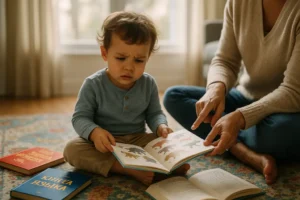
For bilingualism, daily play is key. It makes the second language a tool for experience, not just study. This is where home learning excels, being both unstructured and part of daily life.
It’s not about perfect grammar over breakfast. It’s about naming things in two languages. Debating blueberries or singing silly songs about toast. This is home learning at its best.
Every playful moment is a chance to grow. Each time you mix languages, you earn dividends. Your home becomes a lab for learning, making it fun and engaging.
Consistency is key, not how much you do. A few minutes of play each day beats a long, forced lesson. Your home is the perfect place for this growth, using everyday moments to achieve big things.
This approach links your heritage language to warmth and discovery. It builds a strong foundation, not one based on correction. The language becomes a part of your senses, like the smell of cookies or a familiar song.
Your goal isn’t just to teach a language. It’s to create an environment where it thrives. This seamless, integrated home learning is the best strategy for lasting bilingualism.
Home-Based Activities
Forget Rosetta Stone; your greatest language-learning tool is currently serving as a footrest for your coffee table. Your living room isn’t just a space for relaxation. It’s a bilingual incubator, a cognitive gym where language muscles get flexed during commercial breaks.
Consider the Indoor Obstacle Course. This isn’t merely a strategy to burn off that post-dinner energy surge. It’s a masterclass in prepositions and action verbs. “Crawl under the table,” you instruct. “Jump over the pillow. Go around the chair.” Now, deliver those commands in Spanish, Mandarin, or Arabic. The physical action cements the linguistic command.
Animal Walks transform your rug into a savanna or barnyard. This is where onomatopoeia meets gross motor skills in a glorious, silly bundle. “Galopa como un caballo!” you shout. “Now neigh!” The connection between sound, movement, and vocabulary becomes visceral, not theoretical.
Then there’s the creative realm. “Put on a Play” or “Action Storytime” turns your sofa into a proscenium stage. This is where Source 3’s “Labeling the World” strategy dovetails perfectly with imaginative play. That blanket fort—the ultimate Family Fort Fun—isn’t just a cozy hideout. It becomes a dedicated linguistic sanctuary, a stage for a bilingual puppet show you craft from socks and cardboard.
This brings us to crafts. Here, we must dismantle the Pinterest-perfect industrial complex. The value isn’t in the photogenic output. It’s buried in the messy, glorious process. The language acquisition happens while creating the labels, designing the props, and negotiating the costume details.
“Pásame las tijeras, por favor,” your child says, reaching. “The blue ones.” This is translational living. It’s the real-time code-switching that happens when the creative mission demands specific tools. The crafts are merely the vehicle; the dialogue is the destination.
An Indoor Camping trip under that same fort blanket extends the immersion. Use a flashlight to “read” a story in the target language, labeling the imaginary stars (“estrella”) and moon (“luna”) on your tent’s ceiling. The environment itself becomes a labeled, interactive textbook.
This home-based approach is stealth education. It wraps vocabulary in adventure and syntax in play. For a deeper dive into turning everyday moments into language lessons, explore these fun bilingual activities. You’re not just building blanket forts or obstacle courses. You’re architecting neural pathways, one creatively negotiated craft project at a time.
Cooking, Crafts & Music
If your kitchen isn’t a place for learning, you’re missing out. It’s where the most delicious language lessons are found. Instead of boring drills, learning happens when you mix flour and words.
Imagine being a chef who speaks like a linguist. “We need dos eggs. Let’s mezclar. Watch it bubble.” Each step teaches new words and ideas. Your child isn’t just baking; they’re learning a new language.
The craft table is another place for learning through play. Here, stories come to life with glue and imagination. Building a sheep isn’t just about the structure; it’s about the story behind it.
Why does this method work? It’s because creating something requires words. When kids build, they need words to describe what they’re doing. This way, vocabulary grows naturally.
Music also plays a big role in learning. It’s a way to make language feel like play. Start with nursery rhymes and then move to more complex songs. Create a dance party where you give commands in your target language.
The body learns through rhythm and repetition. It’s a way to make language feel natural. Dancing to the beat helps remember new words and how to say them.
Cooking, crafts, and music together create a powerful way to learn a language. They turn everyday activities into chances to practice and learn. The kitchen, craft table, and dance floor become places where language comes alive.
Neighborhood & Community Events
Learning a language in a classroom can feel a bit artificial. It’s like a plant that never sees the rain. The real learning happens when language meets life outside. Your local area is a living, breathing textbook for practical bilingual activities.
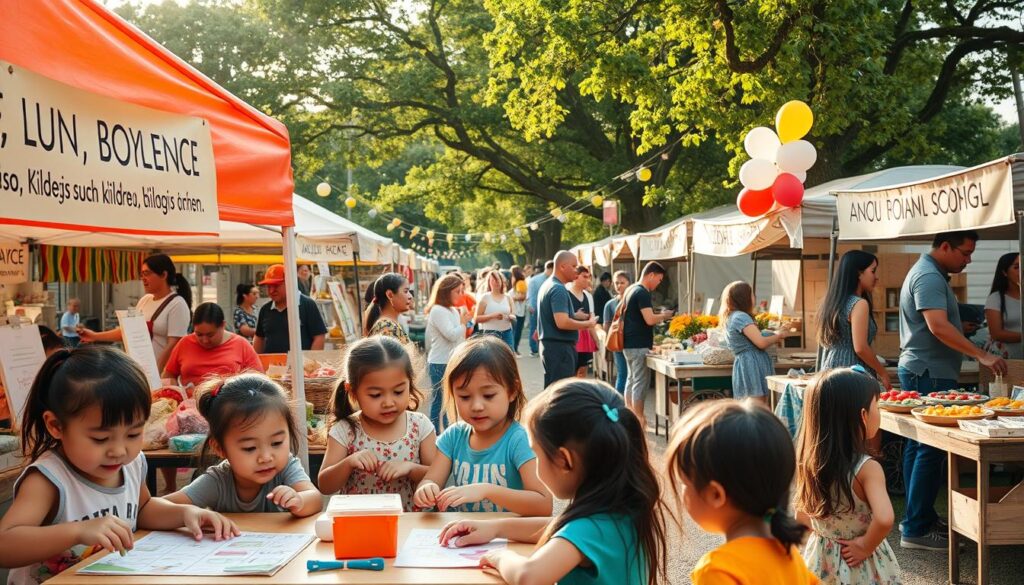
Imagine turning a simple park visit into a bilingual adventure. Give your child a list to find things like a pine cone (piña) or a yellow flower (flor amarilla). It’s not just play; it’s learning through exploration.
But the best place for learning is your local ethnic grocery store. It’s not just shopping; it’s a cultural journey. “This is jicama. We call it jícama. Let’s find a recipe.” You’re using all your senses and connecting language to heritage.
Your community calendar is full of hidden language lessons. Look for:
- Bilingual library story times: Where you can practice listening and speaking.
- Cultural street fairs and festivals: A great chance to talk about your family’s language and history.
- Community center classes: Any class taught in another language is a great opportunity.
These outings are key to learning. They turn words into real, memorable experiences. The word for “dumpling” is forever linked to the smell of festival stalls. The term for “music” is tied to the park concert’s rhythms. This is learning that connects language to place and belonging. So, close your books and step outside. The best bilingual activities are right outside your door.
Bilingual Clubs/Groups
The best way to improve bilingual skills isn’t apps—it’s talking to others who speak your language. Humans are social creatures. Language shows who we belong to. Finding a group of people who speak your language can change everything.
It’s about making socializing a regular part of life. This way, learning a language becomes fun, like playing with friends. It moves away from feeling like homework.
So, where can you find this language family? Look in your community. Check out bilingual playgroups at libraries or community centers. Or, start your own Saturday school for your language.
Even small gatherings, like a “Spanish Playdate” at the park, can make a big difference. Kids learn by playing with friends who speak their language. It’s a powerful way to learn.
Technology can help a lot. Regular video calls with family abroad are great for practicing your language. Make these calls a regular part of your daily routines. It’s like a piano lesson.
Think about the different groups you can join or start:
- The Micro-Tribe: Your own playgroup or club. It’s fun and low pressure.
- The Local Tribe: Community groups or schools. They offer structure and social interaction.
- The Global Tribe: Family abroad via video call. It’s real and emotional.
Each group answers the question: “Who else speaks this way?”. Seeing friends, teachers, or family on screen motivates kids. It shows them the language is used all over the world.
When these interactions become part of your daily routines, magic happens. The language becomes a part of their world, not just something they do with you. It becomes a natural part of their life.
Bilingual clubs and groups give kids the social proof they need. They make learning a language fun, like sharing jokes or playing games. It turns daily routines into social rituals and makes learning a second language natural.
Tracking Growth
Watching your child grow their language skills is like being an anthropologist at home. It’s not about checking off boxes like a report card. It’s about seeing their mind grow in real time.
Forget the spreadsheets. Use your phone, a journal, and your ears instead. This isn’t about making your child feel like they’re being graded. It’s about enjoying the journey of learning a new language.
So, what are you looking for? Look for those special moments. Like when they say “agua” without being told. Or when they mix words in a sentence in a funny way.
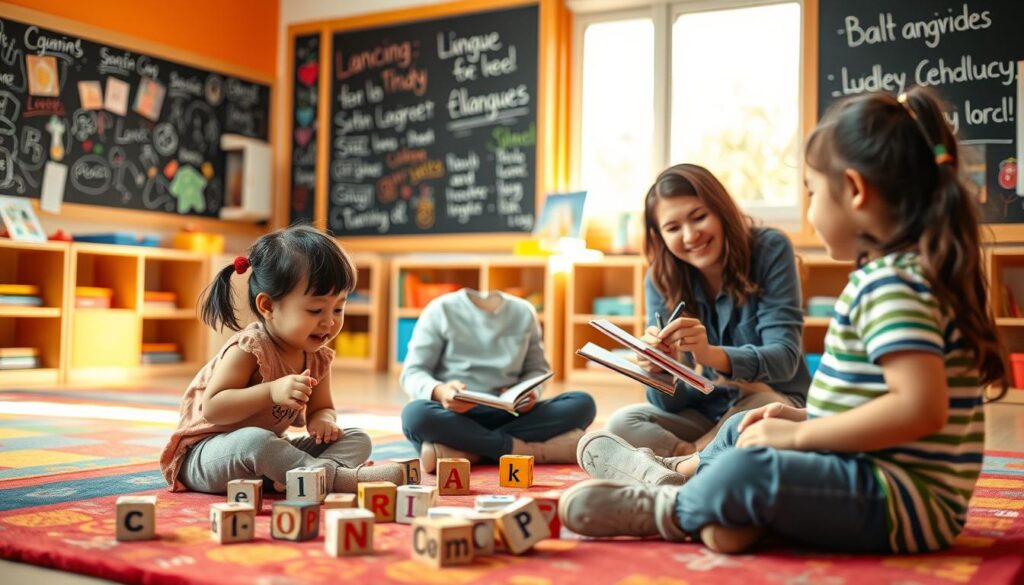
This is your data. It’s raw and full of life. Start a journal to keep track of these moments. It could be a photo of them cooking or a clip of them telling a story.
This isn’t about measuring progress. It’s about celebrating every step of the way. You’re charting a path that’s unique to your child. This helps you see what works best for them.
Think about how different these two ways of tracking are:
| Tracking Aspect | The Corporate KPI Model | The Ethnographic Observation Method |
|---|---|---|
| Primary Tools | Spreadsheets, checklists, standardized tests | Journal, camera, your attentive ears and eyes |
| Focus of Measurement | Correctness, speed, volume against a benchmark | Spontaneity, comfort, joy, and communicative intent |
| Key Data Points | Test scores, word counts, error rates | First spontaneous use, code-switching moments, creative expressions |
| Desired Outcome | Meeting targets and proving progress | Understanding patterns and celebrating unique growth |
| Parental Mindset | Evaluator and assessor | Curious observer and documentarian |
This way of tracking helps you understand what works best for your child. It shows you which activities really help them learn. You can then focus on what’s already working.
You’ll start to notice patterns you hadn’t seen before. Maybe music helps them learn words faster than flashcards. Or maybe telling stories at night helps them learn more complex grammar. This isn’t about watching them. It’s about paying close attention to their learning.
In the end, this journal becomes a special family treasure. It shows how your child built a bridge between two languages. It’s not just about tracking growth. It’s about collecting the treasures you find together along the way.
Conclusion
So, what’s the final score on raising bilingual kids? It’s not about winning a language olympics. Think of it more like jazz improvisation than classical sheet music.
The most authentic bilingual activities weave through daily life like a familiar melody. They’re in the kitchen chaos with a family recipe from Oaxaca. They’re in the living room parade with Duolingo’s silly animal sounds as backup singers.
This isn’t a curriculum to follow. It’s a philosophical shift to make. Nurturing bilingualism works best as an invitation, not an instruction manual. You’re inviting your heritage language to join the daily dance.
Remember the sage advice from language experts: consistency beats intensity every time. Joy trumps rigor. Your child’s connection grows through memories, not flashcards.
Those creative bilingual activities we’ve explored aren’t homework assignments. They’re simply life, viewed through a bilingual lens. The spark happens when language meets lived experience.
Now turn off this screen. Go live that bilingual reality with your kids today.