Parenting is like an improv show, but with Cheerios instead of applause. But, those daily routines are more than just survival. They’re actually secret language laboratories.
These routines, like breakfast and bedtime, create a safe space. Here, kids feel safe to try out new words.
It’s like building muscle through repetition. The more they hear “Time to brush teeth,” the stronger their language skills get. The key is in meaningful repetition.
Every repeated phrase adds to their language skills. These routines turn into family jokes and secret handshakes. It makes learning to speak feel like joining a cool club.
Examples of Play-Based Routines
Did you know the secret to better language skills is in your toy box? Forget boring drills – the real magic is in making speech fun.
Let’s explore how family routines for speech work. These aren’t old-school language lessons. They’re fun play missions that help with speaking.
Imagine your living room as a restaurant where everything costs one dollar. Your four-year-old is the chef, making up menus on the spot.
This isn’t just play. It’s about building stories and practicing dialogue. Kids are running their own theater, learning language skills without even trying.
Board Games: Verbal Sparring Matches
Guess Who? turns into a lesson in asking questions. “Does your person have glasses?” is more than a game move. It’s learning about sentence structure.
Board games lead to natural conversations and thinking ahead. It’s like preschool debate club, but with fun pieces and comfy clothes.
Story Creation: Narrative Ninja Training
When a child makes a story from picture cards, it’s magic. They learn about stories, cause and effect, and how to describe things. All while thinking they’re just playing.
This is how vocabulary grows naturally. They’re not just memorizing words. They’re using them to create worlds.
The best part? Kids don’t even realize they’re learning. The fun of play hides the learning, making it feel like a secret mission.
These play-based routines make learning to speak fun and easy. Language skills grow naturally, wrapped in laughter and creativity.
How to Start and Stick With Routines
Starting routines is like teaching a cat to use a smartphone. It’s all about the small steps and being realistic. I call these small steps “micro-routines.” They help build strong routine-based learning habits.
Don’t try to change everything at once. Start with something small, like a daily habit. Focus on one thing you can improve each day. This approach helps you stick to your routines.
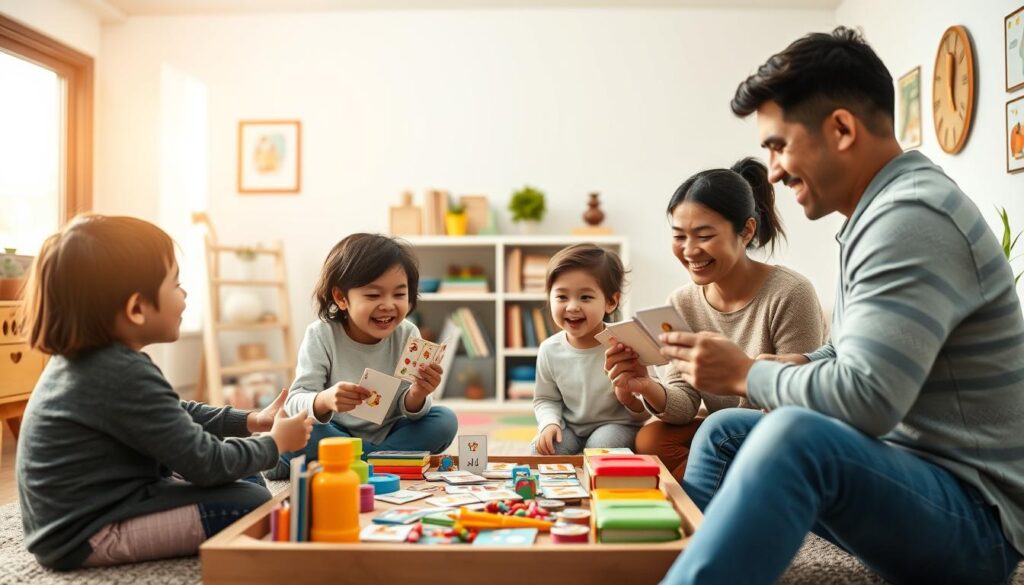
Use the same phrases every day to create a family mantra. This makes your daily activities feel more natural. It’s the key to a successful routine-based learning environment.
Then, there’s the power of silence. Waiting for a response is not just waiting. It’s a chance for your child to practice speaking.
When they do speak, help them by expanding their words. Say “More cookie, please!” instead of just “Cookie.” This helps them learn new words without feeling overwhelmed.
Always celebrate their efforts, no matter how small. We’re building habits, not solving world problems. Even superheroes start with their cape before saving the day.
| Strategy | Implementation | Expected Outcome |
|---|---|---|
| Micro-Routines | Start with 1-2 predictable activities daily | Reduced stress, increased participation |
| Consistent Phrases | Use same words during specific routines | Faster language acquisition |
| Strategic Pausing | Wait 5-7 seconds after speaking | More verbal responses from child |
| Language Expansion | Add 1-2 words to child’s statements | Natural vocabulary building |
| Celebration Protocol | Acknowledge every communication attempt | Increased motivation to communicate |
The magic of routine-based learning is in the small moments. It’s like compound interest for learning. Small, consistent efforts lead to big results over time.
Creating routines is not about perfection. It’s about making progress every day. Some days will be great, others not so much. But every day is a step forward in teaching your child to communicate.
Building a Play “Toolkit”
Forget the expensive toys that break easily. Your daily language routines need better. A good play toolkit is about choosing wisely, like MacGyver.
The key to language development is dress-up clothes, board games, and storytelling props. That sparkly pirate hat opens up a world of words like “plunder” and “treasure.”
Board games teach kids to negotiate with words. Games like Scrabble Junior or storytelling games focus on words over points. Your living room becomes a place where kids learn to describe and ask questions.
Storytelling cards and puppets are magic. Those picture cards start amazing stories. A simple sock puppet can lead to tales that improve sentence structure and plot.
My rule is simple: if it can’t handle a fight, it’s not worth it. The best tools are often free or made from things you already have. That cardboard box is a spaceship, castle, and conversation starter.
Accessibility is key. Keep your tools within reach but change them often. This keeps things exciting without buying new things. It’s not about having lots of stuff; it’s about having the right stuff.
Your daily language routines need tools that spark creativity. Dress-up clothes help kids become characters. Picture books are treasure troves of vocabulary. Even everyday items can spark language adventures.
Remember, the goal is to keep kids talking, not to keep things tidy. A little mess is better than a collection that never gets used. Your daily language routines will thank you for the chaos.
Celebrating Progress
Imagine you’re the hype man for the world’s tiniest rapper. Your job is to add explosive energy to every syllable, even small ones like “ba-ba-ba.” The magic lies in the tiny victories that many overlook.
That mispronounced word is not a mistake; it’s an experiment in language. That gesture, instead of a failure, shows creative problem-solving. These moments should be celebrated, not corrected.
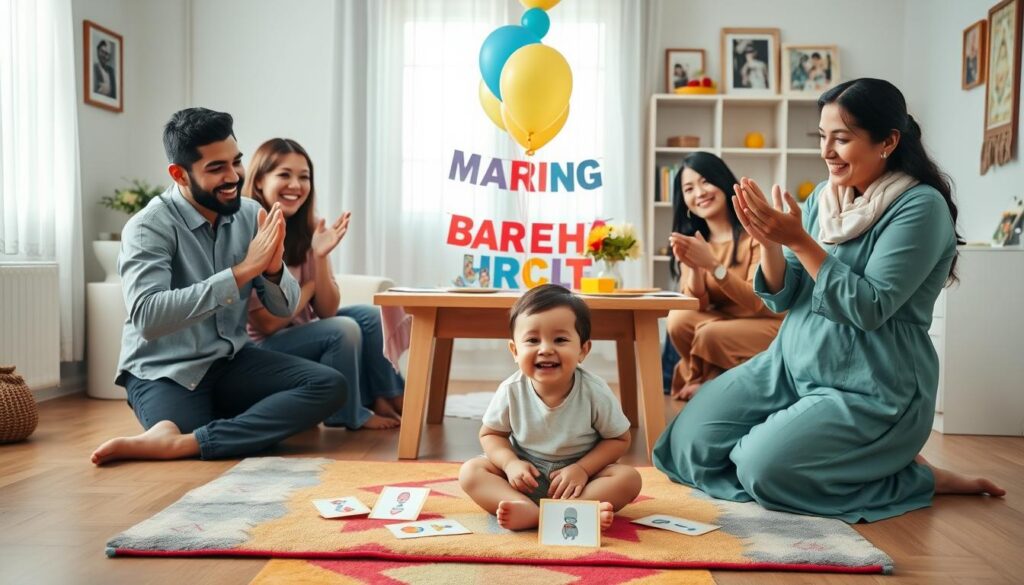
My approach to celebrating has three key rules: be specific, sincere, and a bit silly. Instead of just saying “good job,” say something like, “I love how you called your shoes ‘sparkly’ – that’s a great observation!” This method boosts vocabulary and encourages communication.
Make communication feel like winning the lottery every time they try. Keep track of their progress like an anthropologist studying an amazing subject (which, let’s be honest, your child is).
Involve the whole family in these celebrations. Make it a team effort where everyone cheers for every small success. This turns your family routines for speech into exercises that build confidence.
We’re not just teaching vocabulary; we’re creating confident communicators. And confidence is what propels them to express themselves freely.
The best family routines for speech include celebrating as a key part. When communication is filled with joy and validation, kids want to do it more. It’s simple: positive reinforcement makes them want to communicate more.
So, let’s celebrate every attempt with confetti. Your excitement today will help build confident communicators for the future.
Tips for Consistency
Consistency in speech development isn’t about being perfect—it’s about finding a rhythm. Imagine yourself as a conductor, guiding the flow of words in your child’s life. This helps shape their communication skills.
Make language practice a part of your daily routines. Use toothbrushing time for consonant practice. Turn car rides into chances to talk. This makes learning feel like a natural part of your family’s life.
The secret to success is the power of pause. That quiet moment after a question is key. It lets your child think and respond. When they do, help them build on their words.
See this as a way your family talks, not just practice. It’s the music of your daily life, getting richer with each repetition.
The Consistency Blueprint
Successful routine-based learning has three parts: predictability, expansion, and adaptation. Stick to the same words and phrases in activities. Build on successes, not start over. And always adjust as your child grows.
| Consistency Challenge | Smart Solution | Language Development Impact |
|---|---|---|
| Forgetting to practice | Anchor to existing routines | Natural integration into daily life |
| Running out of ideas | Use a play “toolkit” | Sustained engagement and variety |
| Child resistance | Pause and wait technique | Builds response confidence |
| Progress plateau | Expand on their language | Accelerates vocabulary growth |
Consistency isn’t about being perfect—it’s about keeping at it. Some days will be great, others not so much. But every day helps your child’s language skills grow.
Think of it like a DJ playing hits over and over. Your child needs to hear words and sounds many times to learn. But you can mix things up a bit, adding new words and changing how you say things.
This method helps with therapy exercises and natural learning. It turns practice into who you are as a family. A family that talks with purpose, rhythm, and growing confidence.
Community Resources
Building daily language routines isn’t a solo task. It’s like joining a supportive secret society. SmallTalk and Kids in Motion offer programs that turn speech development into fun adventures.
Your local library is like a cultural exchange. Bilingual books help kids learn new words. KIT, Building Blocks, and Kara’s Kit make learning fun for all.
Don’t underestimate the power of other parents. That mom at the playground might become your ally. Online communities and Communication Community offer help anytime.
Seeking help doesn’t mean you’ve failed. It means you’re building a team for your child’s language growth. It takes a community to raise a confident speaker.